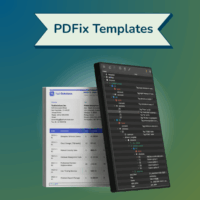




PDFix Templates
Produced by PDFix
Introducing PDFix Templates: Automating Accessible PDF Layouts at Scale
Creating accessible PDFs at scale remains one of the most persistent challenges for organizations working with complex, high-volume documents. At PDFix, we’ve been focused on closing that gap between accessibility requirements and real-world production workflows.
With the introduction of PDFix Layout Templates, now available in PDFix Desktop and PDFix SDK, we’re sharing a new approach designed to help organizations automate structured, accessible PDF creation – consistently and efficiently.
What are PDFix Templates?
PDFix Templates allow users to define layout-aware rules that describe how content such as headers, footers, tables, lists, images, and artifacts should be identified and tagged across documents with the same structure.
Instead of manually remediating each PDF, a single reusable JSON template can be applied to thousands of similar documents – producing predictable tagging, reading order, and accessibility metadata aligned with PDF/UA, WCAG, and Section 508 requirements.
Why templates matter in accessibility workflows
From our work with enterprises, publishers, and public-sector organizations, a few needs come up consistently:
- Consistency across documents
Templates ensure the same structural logic is applied every time, reducing variability in tagging and validation results. - Automation at scale
Once defined, templates can be used in batch workflows to process large document collections without manual intervention. - Layout-aware tagging
Templates support both fixed and dynamic bounding boxes, allowing rules to adapt to repeating but flexible page layouts. - Workflow integration
PDFix Templates are available via PDFix SDK (Python, Java, C#, REST) and integrate into existing document pipelines and content systems.
How it works (at a high level)
- Define a template
Specify rules for structural elements such as headings, tables, lists, figures, and artifacts. - Automate processing
Apply the template across document batches with similar layouts, automatically detecting content and excluding decorative artifacts. - Integrate and scale
Use templates within automated workflows, document management systems, or custom accessibility pipelines.
From theory to practice: enterprise adoption
PDFix Templates are already being used in production environments. A notable example is Deutsche Bank, which integrated the PDFix SDK and template system directly into its document creation workflow.
By embedding accessibility rules at the document generation stage, Deutsche Bank was able to automate PDF/UA compliance as part of standard publishing – rather than treating accessibility as a downstream remediation task. This approach helped standardize tagging, reduce manual effort, and scale accessible document output across large volumes.
Read the Deutsche Bank case study: How Deutsche Bank Automated PDF Accessibility Compliance with PDFix SDK
Learn more
This article provides a brief introduction for the PDF Association community. Detailed technical documentation, examples, and case studies are available on pdfix.net.
Watch Template Video