






You tagged PDFs for screen readers. Turns out the machines needed it too.
ArticleAugust 13, 2026
ArticleAugust 13, 2026

About Benson Hendall, PDFSmart
The views expressed in this article are those of the author(s) and do not reflect the policies or positions of the PDF Association.
For twenty years, the logical structure inside a tagged PDF had essentially one constituency: assistive technology, and the accessibility teams obliged to serve it. Then the primary reader of the world’s PDFs quietly stopped being human. The structure layer built for screen readers turns out to be exactly what large language models need, and most documents still don’t have it.
Two layers, and we only ever cared about one
Open an ordinary PDF and, structurally, it tells you almost nothing about itself. An untagged PDF is a description of appearance: put this glyph here, in this font, at these coordinates; draw this line; place this image. It is a set of marks on a page, faithfully positioned. What it is not, is a description of meaning. Nothing in that file says “this run of text is a heading,” “these cells form a table,” or “read this column before that one.”
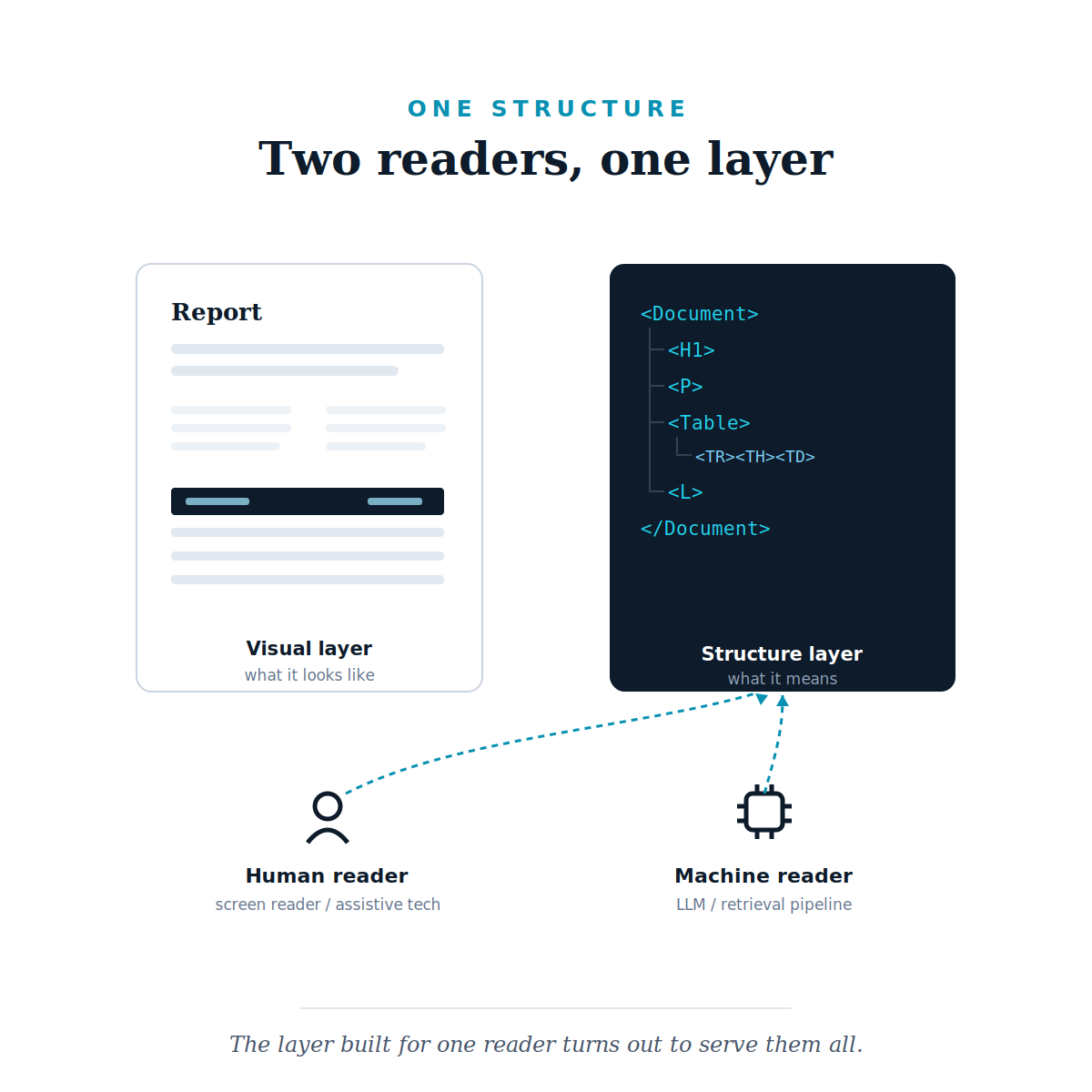
A tagged PDF adds exactly that missing layer. Its structure elements (headings, paragraphs, lists, tables, figures) are linked into a logical structure tree, rooted at an object the specification calls the StructTreeRoot, and organised through parent-child relationships. Crucially, that tree defines a reading order that is independent of the order in which content was written to the page. The visual layer says where things sit. The structure layer says what they are and in what sequence they mean something. Two layers. For most of PDF’s life, the world only ever cared about the first.
Built for a small, essential audience
The structure layer was not built for search engines or data pipelines. It was built for accessibility: so that a screen reader could announce a heading as a heading, navigate a table by rows and columns, and follow a document in the order a human meant it to be read. That is a vital job for a vital audience. It is also, historically, a narrow one in the eyes of the people producing documents.
Because tagging has a cost. It has to be done well, by an authoring tool that supports it or by hand afterwards, and many common tools simply don’t produce it. Export from certain everyday editors and the tags never appear. For a great many organisations, accessibility was filed under compliance: a box to tick when regulation required it, not a benefit to pursue. So the layer existed, fully specified and quietly powerful, and most of the world’s PDFs went out into the world without it. Not because it was useless, but because its only recognised beneficiary was seen, wrongly, as someone else’s problem.
The reader changed
Then something shifted underneath the format. The reader that now consumes PDFs at the greatest scale is not a person. It is a language model, a retrieval pipeline, an agent ingesting documents by the million to answer questions about them. And this new reader, faced with an unstructured PDF, is in precisely the position a screen reader was in decades ago: handed a flat stream of positioned marks and asked to reconstruct meaning that the file never declared.
It does not do this well. A multi-column layout gets read straight across the page, splicing together text from columns that were never meant to touch. A table collapses into a wall of unformatted text, its row-and-column relationships, the entire point of a table, gone. Reading order is inferred from font size, indentation and position on the page, heuristics that fail exactly where documents get interesting. The consequences have names now: broken retrieval, hallucinated figures, answers that cite the wrong cell. The machine is guessing, because the document asked it to guess.
The same layer, a new reason
Here is the part worth sitting with. The structure that would fix all of this is not something new that has to be invented for the AI era. It is the accessibility layer, unchanged. When a parser can read the structure tree, it gets semantic ground truth instead of heuristic guesswork: headings that are known to be headings, tables whose cells retain their relationships, a reading order that is declared rather than reverse-engineered. The same tags that let a screen reader navigate a document let a retrieval system chunk it by meaning rather than by an arbitrary character count. One layer, two readers.
There is a neat closing irony in it. Language models have become good enough at semantic judgement that they can now assess whether a document’s reading order actually makes sense, a task automated accessibility checkers have long punted to “needs manual review.” So the machine reader is at once the party that most needs the structure layer and, increasingly, a tool that can help produce and verify it. This is the same fault line I have written about before on this site: a document that renders beautifully is not the same as a document a machine can read. What has changed is who is doing the reading, and how many of them there now are.
What this changes for anyone who makes PDFs
Three things follow, and none of them is a tagging tutorial. First, logical structure has stopped being purely a compliance cost and become an investment in machine legibility; the document you tag for a screen reader is the document an AI pipeline can actually parse. Second, human-readable and machine-readable were never a trade-off. A tagged PDF serves both in a single act of authoring, which is the same lesson hybrid document formats learned the hard way. Third, a document whose meaning has to be guessed by its reader is a fragile document, whether the guesser is assistive technology or a large language model. Meaning that lives in the file survives; meaning that depends on the reader’s inference does not.
The accessibility community built this layer for a small audience and was often thanked for it grudgingly, if at all. It turns out they were building the layer every reader would eventually need. The machines were simply the first constituency large enough that the rest of us finally noticed.
