






iText Suite 9.8: Vertical Text Layout, Richer SVG, and Accessible Markdown-to-PDF

Member NewsOctober 19, 2026
Member NewsOctober 19, 2026

About Apryse
The views expressed in this article are those of the author(s) and do not reflect the policies or positions of the PDF Association.
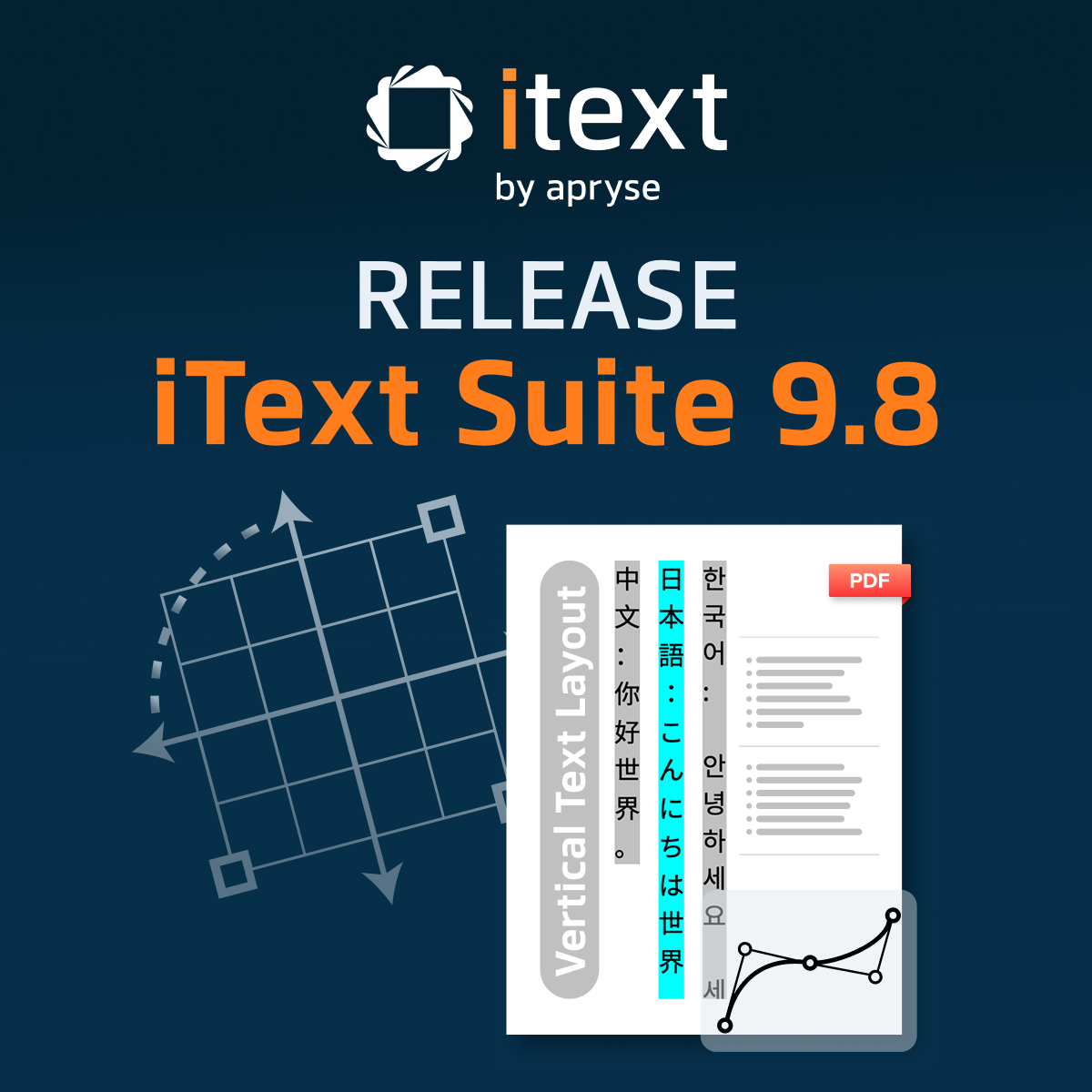
This iText Suite release from Apryse focuses on layout and graphics. The headline is initial support for vertical writing modes in the layout engine, aimed at CJK documents. SVG conversion gains radial gradients, masks and full stroke styling, and transforming layout elements is now much simpler. Outside the layout work, pdfSweep closes a gap where redacted content could survive in the structure tree of tagged PDFs, and we've released a free GitHub Action that produces PDF/UA-2 documents from Markdown.
Vertical Text Layout for CJK Documents
Vertical writing is still widely used in Japanese, Chinese (especially Traditional Chinese) and Korean: in books, newspapers, legal and formal documents, certificates and signage. Until now, producing it with iText meant workarounds, or inserting images of correctly oriented text.
PDF does have a mechanism for this by using fonts with a vertical CMap, but it can lead to inconsistent results as things like rotation of characters such as brackets and dashes are left to the viewer.
iText Core 9.8.0 takes a different route. Vertical text is handled entirely by the layout engine, which measures and positions each glyph individually along the vertical axis, using standard text operators and per-glyph text matrices. Characters that should be rotated in vertical text follow the orientation classes in Unicode's UAX #50, and short runs such as two to four digit numbers can be set horizontally within the vertical line (tate-chū-yoko), as in Japanese typesetting. Because nothing depends on viewer behavior, the output looks the same everywhere.
Since this lives in the layout engine rather than at the level of text placement, vertical text works inside tables, flex containers and inline blocks, and supports line breaking, right-to-left column progression, alignment, spacing, overflow, text decorations and text rise. It's also fully tagged, so vertical content remains accessible to assistive technology.
This is initial support. The focus for this release is upright orientation, and the vertical text API is now finalized, so developers can build on it while we continue refinements in upcoming releases.
pdfHTML 6.3.4: CSS Writing Modes
pdfHTML, iText's add-on for converting HTML and CSS into PDF, builds directly on the new layout support. HTML templates can now produce vertical text using writing-mode: vertical-rl or writing-mode: vertical-lr combined with text-orientation: upright, bringing PDF output closer to browser rendering for East Asian documents. Sideways and mixed orientation are not yet covered.
The work comes with an extensive test suite covering CJK fonts, spacing, alignment, floats, images, inline blocks, mixed font sizes and min/max width behavior, along with extreme values and boundary conditions to guard against infinite loops and other conversion failures.
This release also tidies up PDF/UA handling when converting partial HTML: empty lang attributes are now handled consistently, rather than producing problems in the resulting structure.
Richer SVG Graphics
iText's SVG support gets a substantial upgrade in fidelity. Radial gradients are now supported across the SVG, Kernel and Layout modules, so the circular color blends common in logos and UI artwork no longer need approximating or rasterizing. SVG <mask> elements are converted into PDF soft masks, preserving shapes that fade or reveal underlying content.
Stroke handling is more complete too, with stroke-linecap, stroke-linejoin and stroke-miterlimit now respected, URL-based stroke references with fallbacks, and fixes for nested clipping paths combined with translations. The practical result is that more SVG artwork arrives in PDF as resolution-independent vector graphics.
Simpler Transformations in the Layout Engine
The layout module now offers more user-friendly affine transformations, with simplified options for Property.TRANSFORM (Java/.NET). Rotating, scaling and skewing elements no longer means working directly with transformation matrices. Alongside this, several long-standing issues have been fixed around rotated table cell sizing, content offsets, rotated page coordinates, and relatively positioned images with borders.
Footnote Navigation
iText Suite 9.7 introduced dynamic page margins and automatic footnotes. In 9.8.0, footnote anchors and footnote bodies are linked in both directions, so readers can click through to a note and straight back again. Footnote anchors also support custom styling, and numbering is more reliable when footers and page breaks are involved.
pdfSweep 5.0.8: Redaction and the Structure Tree
pdfSweep, iText's add-on for secure redaction, addresses a customer-reported issue relating to tagged PDF.
Previous versions removed text, paths and images from the page content within redaction areas, but /ActualText and /Alt entries could survive, both on structure elements in the structure tree and on marked-content sequences in the content stream. Since that text is exactly what screen readers and text extraction tools rely on, redacted content could still be recovered from an apparently clean document.
In pdfSweep 5.0.8, /ActualText and /Alt entries for content covered or intersected by a redaction area are sanitized in both places. Multi-level structure hierarchies are taken into account, so replacement and alternate text defined on a parent element is also redacted when its child content falls within the redaction zone. Visual and structural redaction are now fully synchronized.
Accessible PDFs from Markdown
Outside the usual iText Suite releases, there is also itext-markdown2pdf, a free GitHub Action that converts Markdown in public repositories into PDF/UA-2 (and WTPDF) documents as part of a CI/CD workflow. READMEs, documentation and changelogs can be published as accessible PDFs automatically on every change, with the source code available on GitHub.
We built it as a gift to the open-source community, and to help encourage adoption of PDF/UA-2 as the current standard for accessible PDF. As an example, an accessible PDF generated from the iText Core README is attached to the iText Core 9.8.0 release notes.
Security and Stability
iText Core 9.8.0 updates several cryptographic and utility dependencies, including Bouncy Castle (both standard and FIPS), Jackson Databind, Apache HttpClient and Logback, and fixes initialization vector generation for encryption. Digital signature validation no longer over-counts document revisions, and canvas processing is now protected against circular form XObject references that could cause a stack overflow.
Validation improvements include correct handling of PDF/A pages with multiple content streams, and more accurate glyph validation for substituted glyphs without Unicode mappings. Compatibility with .NET 10 and GraalVM JDK 24/25 has been improved, and a text extraction performance regression has been fixed by restoring font caching for the standard 14 fonts.
Community contributor netliomax25-code also improved CSS ~= attribute selector matching in pdfHTML, their second contribution in consecutive releases.
Release Notes and Showcase PDF
You can find more on what's new in iText Suite 9.8 in the release announcement, or check the release notes on the iText Knowledge Base for full technical detail, downloads and related documentation. Changelogs for pdfCalligraph 5.1.1, pdfOCR 5.0.2, pdfOptimizer 4.1.5 and pdfXFA 5.0.8, also updated alongside this release, are available there too.
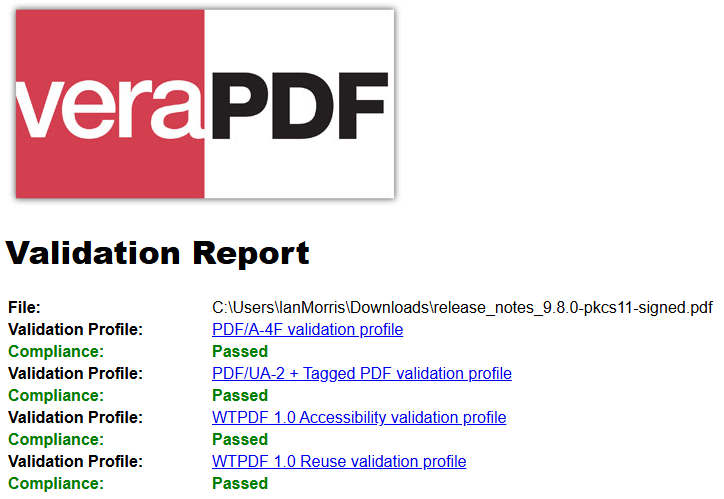
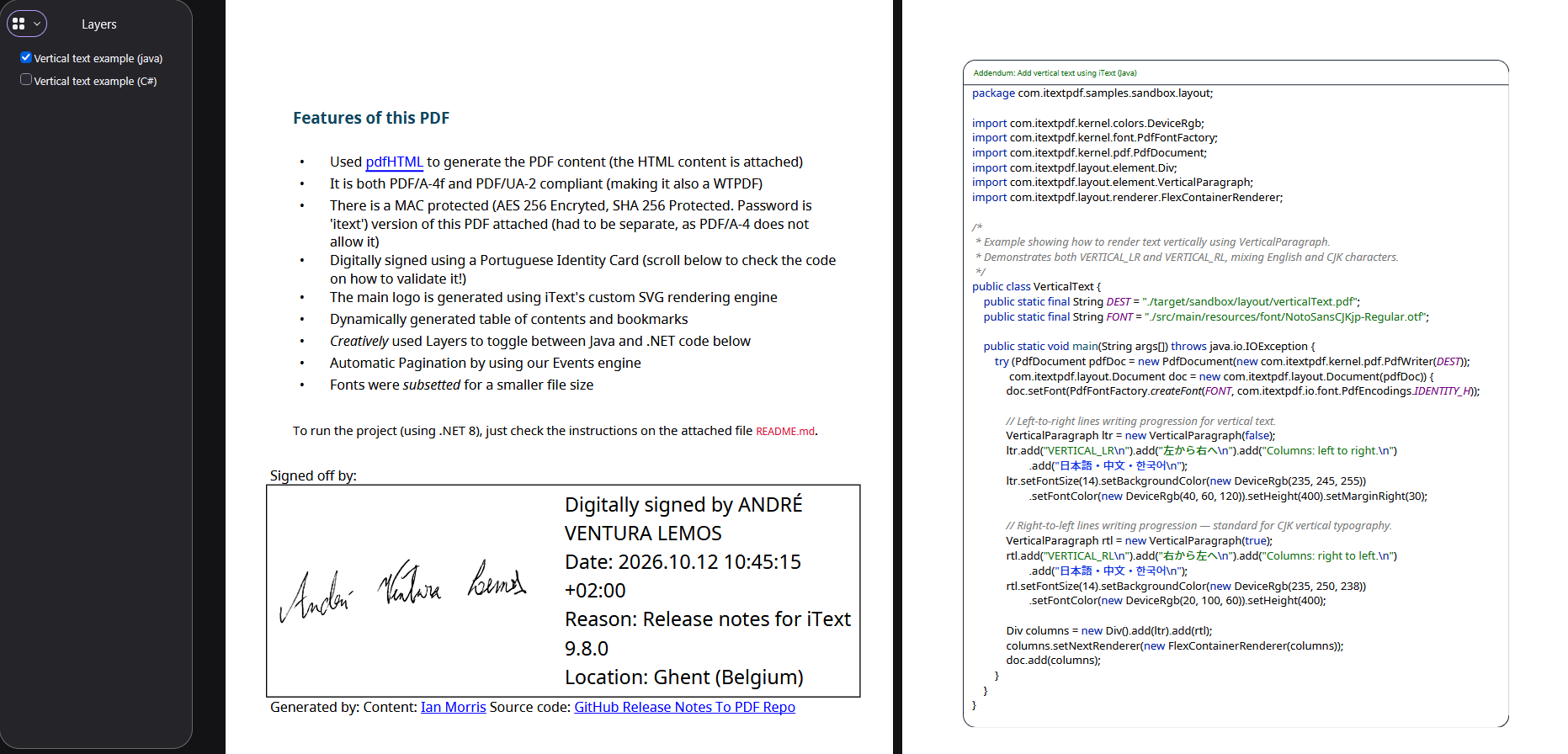
As with every release, we've turned the iText Core release notes into a showcase PDF document. It is a PDF 2.0 document that conforms to PDF/A-4F, PDF/UA-2 and WTPDF, is digitally signed, and has its own source code and resources embedded so you can regenerate it yourself.
This time it demonstrates both vertical text and the new transformations, and includes Java and C# examples of rendering text with VerticalParagraph, switchable using optional content (layers).

Apryse, formerly PDFTron, is a global leader in document processing technology, committed to making work better and life simpler. Apryse gives developers, enterprise customers, and small businesses proven tools to reach their document goals faster and easier. Our product portfolio includes Apryse SDK, WebViewer, iText, and XODO, offering solutions across…
Read more