




What developers really mean when they say they need PDFs
ArticleMarch 31, 2026
ArticleMarch 31, 2026

About Anne Lazarakis, Iron Software
Developers rarely begin a project by asking for a PDF. They begin with something more specific: invoices that must render identically across every environment, reports that serve as legally binding records, audit trails that need to survive long-term archival. The PDF is simply where those requirements converge — the agreed-upon container for information that must be reliable, portable, and permanent.
That framing matters, because it changes what “generating a PDF” actually means in practice.
The problem is rarely the conversion itself
On the surface, PDF generation appears to be a rendering problem: take structured data or HTML, convert it to PDF, deliver the file. In most implementations, the conversion step works. What breaks — or creates downstream cost — is everything surrounding it: inconsistent rendering across environments, structural markup that looks correct visually but fails under automated processing, and documents that meet initial requirements but become liabilities as workflows evolve.
Understanding why requires looking at where PDFs actually sit within modern software systems.
From endpoint to workflow component
For most of the document format‘s history, the generation step was also the final step. A document was produced, sent, and archived. The workflow was linear and largely manual.
That model has changed substantially. Documents now move through broader lifecycles involving multiple systems and stakeholders: generated from source data, reviewed and annotated collaboratively, approved through structured workflows, then extracted from and analysed at scale. In regulated industries, the same document may need to satisfy compliance requirements, feed into records management systems, and remain accessible and interpretable for decades.
This shift reflects a deeper change in how organisations treat documents. They are no longer static outputs at the end of a process. They are active components within it — and the decisions made during generation directly constrain what is possible in every subsequent stage.
A layered view of the modern document lifecycle
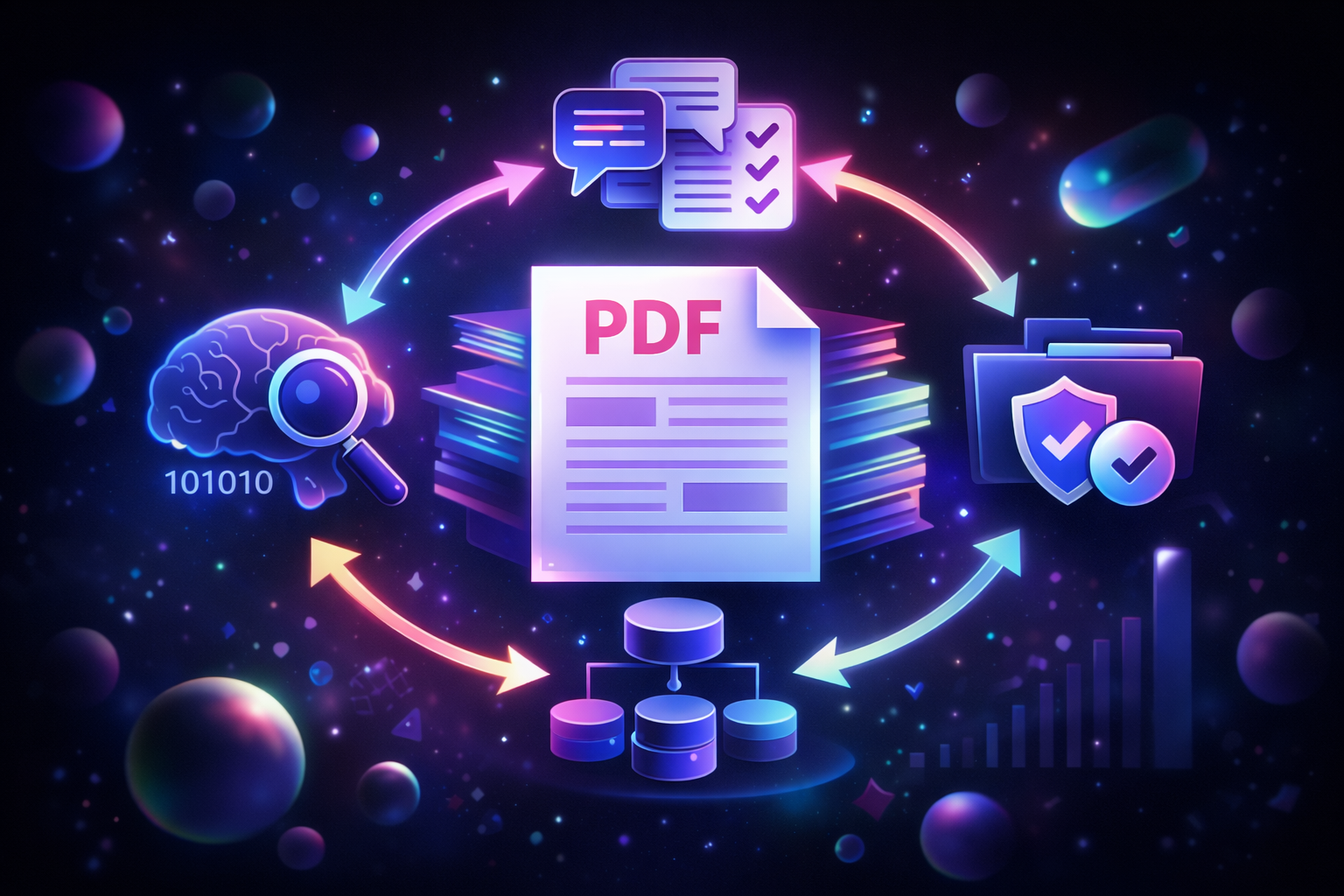
It is useful to think about document handling in three distinct but interdependent layers.
The first is generation: producing documents from source data, typically via HTML templates, structured inputs, or programmatic composition. This layer is where most implementation effort is concentrated, and where structural decisions have the longest downstream reach.
The second is interaction: the collaborative layer of review, annotation, and approval. As document workflows have become more distributed, this layer has grown significantly. Tools purpose-built for structured review and sign-off are increasingly common, particularly in legal, financial, and regulatory contexts.
The third is intelligence: extracting structured meaning from documents for downstream use — whether that means feeding data into other systems, enabling compliance verification, or supporting large-scale analysis. This layer was historically manual or rule-based; it is now increasingly automated.
These layers are often implemented independently, by different teams using different tools. But they are tightly coupled. A document that is poorly structured at the generation stage will introduce friction at every subsequent layer — unreliable extraction, failed accessibility checks, and increased manual intervention to compensate for what the original output did not provide.
Why structure matters more than visual fidelity
A document that looks correct is not necessarily structured correctly. For documents consumed only by human readers in controlled conditions, the distinction may not surface. But for documents that pass through automated systems, serve as inputs to assistive technologies, or are stored for long-term archival and retrieval, structure becomes the more critical property.
Structural integrity in a PDF context means accurate tag hierarchies, consistent metadata, meaningful reading order, and correct semantic markup — not simply correct visual layout. These properties are what allow a document to be processed reliably by systems that were not anticipated at the time of creation.
When structure is treated as secondary to appearance, the consequences tend to compound. Extraction pipelines require additional error-handling. Accessibility audits flag remediation work. Compliance reviews surface gaps that are expensive to address retrospectively. In aggregate, these costs frequently exceed the original investment in document generation.
The effect of AI on document requirements
The growing use of AI in document workflows has made structural quality a more pressing concern, not less. Documents are increasingly read by systems as well as people — processed by language models, classification pipelines, and retrieval systems that depend on consistent, predictable input.
For these systems to function effectively, documents must be structurally coherent. Inconsistent tagging, ambiguous reading order, or missing metadata introduces noise that degrades downstream accuracy. This is particularly consequential in high-volume or high-stakes contexts, where the cost of errors compounds across large document sets.
The implication for developers is significant: document generation is no longer just an output concern. It is an input concern for the next system in the chain. The quality of what is produced at the generation stage determines the quality of what is possible at every subsequent stage.
Bridging implementation and organisational outcome
There is a persistent gap between how document generation is typically scoped and what organisations ultimately require from their documents. Developers are, reasonably, focused on producing correct output — a document that renders accurately and meets the specified requirements at the point of delivery.
The broader organisational need, however, extends further: documents that support auditability, meet accessibility standards, remain compliant over time, and integrate reliably into the systems built around them. When these requirements are not surfaced early, they tend to be addressed through additional layers added after the fact — retrofits that are almost always more costly and less reliable than getting the foundation right.
This gap is not a criticism of any particular implementation. It reflects the fact that document requirements are often distributed across teams who do not naturally share the same view of the problem. Developers see a generation task. Legal or compliance teams see a records management obligation. Accessibility teams see a remediation backlog. Connecting those perspectives early produces better outcomes across all of them.
Rethinking the PDF as an interface
Perhaps the most useful reframe is this: a PDF is not a file. It is an interface — between data and presentation, between internal processes and external communication, between human interpretation and machine processing.
Treating it as an interface changes the questions worth asking at the outset. Not only “does this document render correctly?” but “will this document behave reliably across the systems it will pass through?” and “will it continue to meet requirements as those systems change?”
These are harder questions to answer at implementation time. But they are the right questions — and asking them earlier is consistently less expensive than addressing them later.
