





PDF errata makeover
PDF in the WildDecember 17, 2025
PDF in the WildDecember 17, 2025
About PDF Association staff
Chrome’s U-turn on JPEG-XL – thanks (in part) to PDF!
In various online articles (such as DevClass and Heise Germany), as well as the Chromium Issue database and Google Chromium Group, the PDF Association’s promotion of JPEG XL as the preferred new image format for HDR is being credited with contributing to the reversal of the Google Chromium team’s previous decision not to support JPEG XL. This influential U-turn is significant as it smooths the way for the (eventual) seamless flow of HDR content between web and PDF. But there’s work to be done!
According to DevClass:
Rick Byers, ATL (area tech lead) on Google Chrome, posted that “we would welcome contributions to a performant and memory-safe JPEG XL decoder in Chromium,” citing support in Safari, potential support in Mozilla Firefox, the announcement of support in PDF, and “developer signals” in the form of upvotes and survey data.
Most of the factors Byers cited are longstanding, so why the change of heart? It may be that forthcoming inclusion in the PDF specification tipped the balance, though Byers also noted a post last month previewing relevant results from the State of HTML survey, which was co-sponsored by Google. The survey showed demand for JPEG XL as among the top pain points cited by developers among proposals for interop 2026, a cross-company project to increase interoperability among web browsers.
As noted in the Chromium issue back in April 2021, a Meta engineer alluded to Chrome’s dominant position as the #1 web browser and its opposition to JPEG-XL as being a significant roadblock, even for Facebook:
Just wanted to chime in and mention that us at Facebook are eagerly awaiting full JPEG XL support in Chrome. We're very excited about the potential of JPEG XL and once decoding support is available (without the need to use a flag to enable the feature on browser start) we're planning to start experiments serving JPEG XL images to users on desktop web. The benefit of smaller file size and/or higher quality can be a great benefit to our users. On our end this is part of a larger initiative to trial JPEG XL on mobile (in our native iOS and Android apps as well as desktop).
A YouTube video of prototype HDR support in Chrome is already circulating, showing the website https://jpeg-xl.info, so we hope to see Chrome’s JPEG-XL support driving more HDR web content in the near future.
Adding JPEG-XL to PDF is also not a minor project given PDF’s rendering complexities. The PDF Association encourages interested developers to join us!
PDF errata makeover
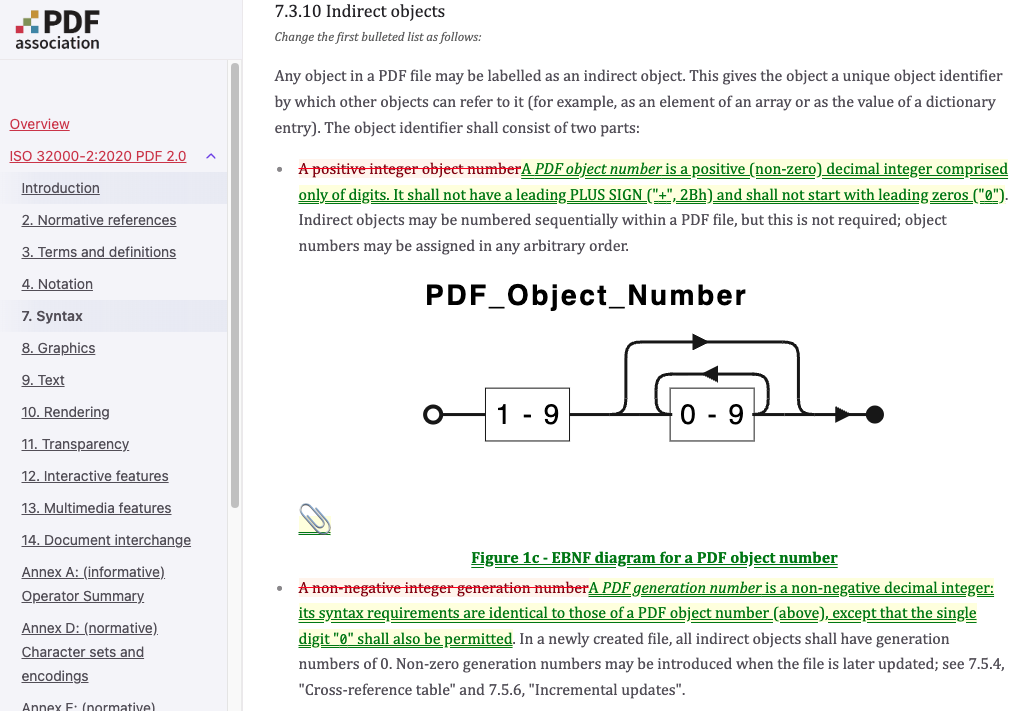
We’ve updated the PDF Association’s PDF errata corrections website with a new look and improved functionality!
A cleaner layout now provides a dedicated navigation pane that supports publication of corrections against a large (and growing!) volume of PDF specifications and standards publications, while offering a better experience on small-screen devices.
The new website includes a fully integrated search feature that operates across all corrections on the site. Bookmarks to corrected subclause headings and tables are retained, ensuring that any existing references to errata corrections in source code or documentation remain valid.
ZUGFeRD 2.4 / Factur-X 1.08 announced
The Forum elektronische Rechnung Deutschland (FeRD, Forum for Electronic Invoicing in Germany) and FNFE-MPE have jointly announced ZUGFeRD 2.4/Factur-X 1.08, the Franco-German standard for hybrid e-invoicing. Both ZUGFeRD and Factur-X are based on PDF/A-3 and – since March 2022 – PDF/A-4f.
The new version is now available for free download in English, German, and French and becomes applicable on January 15, 2026.
Library of Congress has “many hundreds of thousands of terabytes” of PDFs!
A new blog post titled “File Format Flair for the Holidays! Updates to the Sustainability of Digital Formats” by the US Library of Congress (a member of the PDF Association and participant in the ISO standardization body for PDF) reports that it has “many hundreds of thousands of terabytes of different flavors of PDF” – that’s hundreds of petabytes!
The article summarises changes in 2025 to the file formats tracked by the Library’s Sustainability of Digital Formats program, including updates to the Format Description Documents (FDDs) for PDF, with new information on PDF/A-4e, PDF/A-4f, and EA-PDF.
Google Drive PDF viewer improvements
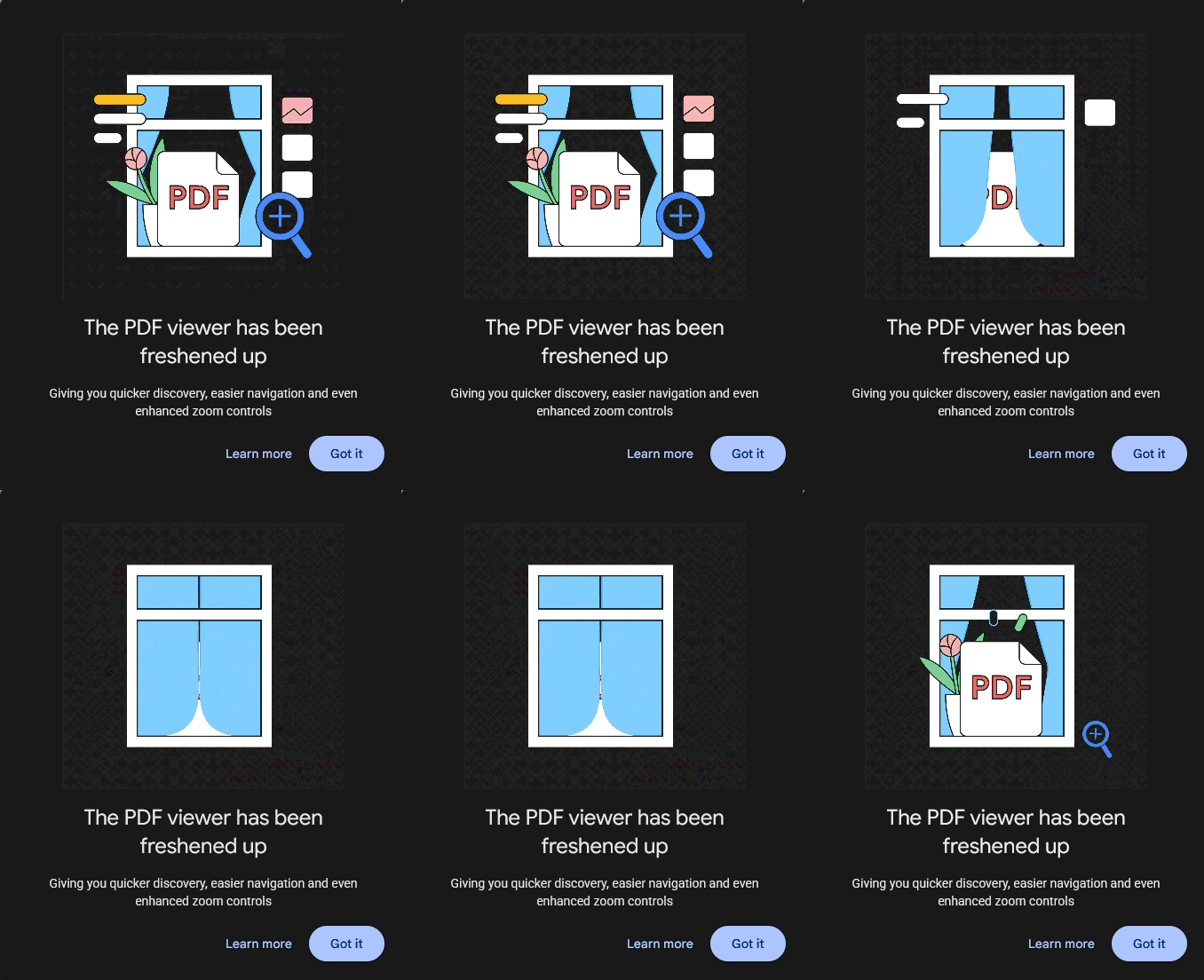
As has been widely reported, and possibly indicated the next time you preview a file from Google Drive, Google is rolling out a “modernized” file-viewing experience with improvements for PDFs, videos, and images.
Improvements include thumbnail and outline navigation (when available) in a new navigation pane, as well as a new File menu, toolbar, Gemini (AI) support, and more.
Is that a real <p>, or an implied paragraph?
Recent discussions across WCAG and HTML have highlighted the nuances of HTML’s explicit vs. implicit paragraphs and how this affects assistive technology (AT) users who navigate using “next paragraph” functionality, potentially leading to unintentional skipping of content.
Although not directly relevant to PDF (beyond some interesting test scenarios for HTML-to-Tagged PDF converters!), this issue illustrates the complex interrelationship between semantics, markup languages, and AT – and even how “[t]he over use of ARIA has taught LLM AI some pretty ridiculous bad practices that now need to be untaught”.
With some exceptions, Tagged PDF, as used by WTPDF and PDF/UA (ISO 14289), the specifications for reuse and accessibility, respectively, don’t need or use implicit semantics. In PDF, tags transmit the author’s explicit semantic intent.
Why precise typesetting is so important
Developers and users who typically use Latin languages are at a disadvantage in understanding the rationale for accurate and precise typesetting in digital documents. That’s because many of the complexities arise in non-Latin languages.
W3C recently published a short YouTube video “The hidden rules of wrapping text on the Web” in which Fuqiao Xue, W3C Internationalization Activity Lead, introduces many of the challenges of text wrapping – as he says, “It’s not always 100% perfect”.
These complexities help to explain the necessity of a fixed-layout format, such as PDF, alongside the less-deterministic reflowable technologies of the web.
With PDF, of course, authors have total control; guaranteed correct and consistent display of their typesetting.
Drafts of PDF/A-4 and EPUB/A are publicly available for comment
As noted in our recent article “(Re)aligning PDF/A and PDF/X”, the dated revision of PDF/A-4 ISO/DIS 19005-4.2 Document management – Electronic document file format for long-term preservation – Part 4: Use of ISO 32000-2 (PDF/A-4) is currently at draft international standard (DIS) status and is available for public review from ISO or at no cost from official liaison organizations such as the PDF Association (members only).
ISO/IEC DIS 22424 Information technology – Digital publishing – Code of practice for EPUB 3 archiving for long-term preservation (EPUB/A) has also achieved draft international standard status and is available for public review from ISO. Comments close for EPUB/A on February 11, 2026.
PDFacademicBot for December 2025
The PDFacademicBot brings academic research on PDF and related technologies to the industry’s attention.
Aggarwal, A. and Kumar, P. (November 2025) “Document classification engine to segregate multilingual PDF documents,” in Computational Intelligence for Connective Cognition Networks. 1st edition. Boca Raton, USA: CRC Press, p. 13. https://www.taylorfrancis.com/chapters/edit/10.1201/9781003569619-7/document-classification-engine-segregate-multilingual-pdf-documents-apeksha-aggarwal-pawan-kumar.
Basso, M., Roberts, K., and Bustamante, F. (November 2025) “DIDACTIC INNOVATION WITH 3D-PDF IN GEOLOGICAL ENGINEERING: A STUDENT PERCEPTION APPROACH,” in ICERI 2025 Proceedings. 18th annual International Conference of Education, Research and Innovation, Seville, Spain: IATED, pp. 859–864. https://doi.org/10.21125/iceri.2025.0382.
Bharat, A. et al. (July 2025) “AI-Based Magazine Creator and PDF Generator,” in 2025 International Conference on Information, Implementation, and Innovation in Technology (I2ITCON), Pune, India: IEEE, pp. 1–5. https://doi.org/10.1109/I2ITCON65200.2025.11210731.
Bhoite, S. et al. (November 2025) “PDF Document Query Analyzer Using Generative AI,” in S. Kumar et al. (eds.) Recent Trends in Artificial Intelligence and Data Sciences. International Conference on Cloud Computing, Data Science and Engineering, Singapore: Springer Nature, pp. 389–399. https://doi.org/10.1007/978-981-96-9203-3_32.
Croke, B. (November 2025) “Intelligent PDF Extraction: Building a Regex-Driven and LLM-Assisted Pipeline for Document Analysis”. https://repository.belmont.edu/surs/286.
Fu, C. et al. (November 2025) “Global Discovery: A Global Graph-RAG Approach for Query-Focused Multimodal Summarization Across Multiple PDF Papers,” in T. Zhu, W. Zhou, and C. Zhu (eds.) Knowledge Science, Engineering and Management. International Conference on Knowledge Science, Engineering and Management, Singapore: Springer Nature, pp. 1–8. https://doi.org/10.1007/978-981-95-3061-8_1.
Huang, Z. et al. (2026) “MultiRAG: An Agentic Multi-Modal and Multi-Source Retrieval-Augmented Generation Framework for Scientific Research,” in M. Liu et al. (eds.) AI 2025: Advances in Artificial Intelligence. Singapore: Springer Nature, pp. 15–27. https://doi.org/10.1007/978-981-95-4969-6_2.
Iqbal, N. et al. (Feb. 2026) “SETPA: Structural evasion techniques for PDF malware detection systems,” Computers & Security, 161, p. 104775. https://doi.org/10.1016/j.cose.2025.104775.
Eraj Khatiwada (December 2025) Utilizing Large Language Models to Provide Qualitative Feedback on PDF Marketing Materials. Master of Science, Integrated Science and Technology. Southeastern Louisiana University. [ProQuest partial preview]: https://www.proquest.com/openview/1291404523d512ece8addf71dbeb5135/1?pq-origsite=gscholar&cbl=18750&diss=y .
Kuznetsov, I.I., Novikov, O.P. and Ilin, D.Y. (November 2025) “Procedure for Comparing Text Recognition Software Solutions for Scientific Publications by the Quality of Metadata Extraction,” Automatic Documentation and Mathematical Linguistics, 59(3), pp. S250–S260. https://doi.org/10.3103/S0005105525700864.
Liu, M. et al. (November 2025) “MultiRAG: AN Agentic Multi-Modal and Multi-Source Rettrieval-Augmented Generation Framework for Scientific Research,” in AI 2025: Advances in Artificial Intelligence: 38th Australasian Joint Conference on Artificial Intelligence, AI 2025, Canberra, ACT, Australia, December 1–5, 2025, Proceedings, Part I. 1st ed. Springer Nature, pp. 15–27. https://books.google.com.au/books?id=c6yaEQAAQBAJ.
Miguel Lopez-Duran et al. (November 2025) “Benchmarking Graph Neural Networks for Document Layout Analysis in Public Affairs,” in Document Analysis and Recognition – ICDAR 2025 Workshops: Wuhan, China, September 20–21, 2025, Proceedings, Part I. 1st ed. Wuhan, China: Springer Nature. https://books.google.com.au/books?id=0YyaEQAAQBAJ.
Mishra, P. and R, G. (November 2025) “Securing e-governance against shadow attacks with blockchain technology,” Scientific Reports, 15(1), p. 42306. https://doi.org/10.1038/s41598-025-26326-0.
Molino, W.M. et al. (December 2025) “Context-Aware PDF Clustering Using Social Spider Algorithm and Agglomerative Hierarchical Techniques,” International Journal of Computing Sciences Research, 9, pp. 4000–4023. https://stepacademic.net/ijcsr/article/view/822.
Nautiyal, A. et al. (December 2025) “SecurePDF-X: A Robust and Explainable PDF Malware Detection Model Leveraging Ensembling Techniques and XAI,” in Intelligent Systems Using Semiconductors for Robotics and IoT. 1st edition. CRC Press, p. 6. https://www.taylorfrancis.com/chapters/edit/10.1201/9781003716389-72/securepdf-robust-explainable-pdf-malware-detection-model-leveraging-ensembling-techniques-xai-aditya-nautiyal-shubhangi-saklani-aaditya-sharma-amit-kumar-singh.
Nosov, P. et al. (November 2025) “Machine Learning-Based Semantic Analysis of Scientific Publications for Knowledge Extraction in Safety-Critical Domains,” Machine Learning and Knowledge Extraction, 7(4), p. 150. https://doi.org/10.3390/make7040150.
Possamai, T.S. et al. (2025) “Use of Machine Learning Techniques for Organizing Digital Documents in PDF Format,” p. 10. [Portuguese] https://sol.sbc.org.br/index.php/eniac/article/download/38850/38623.
Soy, M. and Zhang, J. (December 2025) “GPT4-Vision Multimodal Model-Powered Query-Answering Chatbot for Bridge PDF Drawings,” Computing in Civil Engineering, 2024, pp. 505–513. https://doi.org/10.1061/9780784486115.053.
Wales, Gregory. S. (November 2025) “Portable document format (PDF) image embedding and analysis: Foundational structures for forensic examination,” Journal of Forensic Sciences [Preprint]. https://doi.org/10.1111/1556-4029.70229.
