





Documents and AI
ArticleNovember 16, 2026
ArticleNovember 16, 2026

About Peter Wyatt, PDF Association
A lot is written about AI and documents, and PDFs in particular. Most of it, however, focuses on the input side, such as document ingestion issues, document summarization, and document questioning. Our AI FAQ addresses many of these questions.
Capturing AI output to PDF or generating PDFs with AI is also common, but less widely discussed. It’s also nowhere near as good as it should be.
PDFs generated by AI
Many people use PDFs to capture, preserve, and share the output of their AI interactions and agents. This is unsurprising, as PDFs provide a reliable, persistent “document of record” independent of the chat session or AI vendor. AI output captured in a PDF or agent-generated PDFs can be archived, shared, and distributed without additional tokens.
AI-generated documents, whether as PDF, EPUB, or another format, should always have the following attributes:
- They should always contain highly reliable semantics. Since AI knows precisely what it is producing, it has no excuse for not generating well-tagged PDFs. That’s especially true considering how much AIs prefer to present information in tabular form!
- All headings, lists, tables, and code blocks should be tagged with semantically correct structure elements.
- All images should have reliable, contextualized alt-text descriptions. The identical image in different documents and different contexts will likely have different alt-text.
- All math should be supplemented with unambiguous machine-readable MathML.
- Headings and other significant landmarks (e.g., tables) should be bookmarked, creating a structured outline with increased citability (see below). This is especially important when AI verbosity often results in long documents!
- Pagination artifacts such as headers, footers, and page numbers are appropriately identified as such.
- Figure tags for charts and graphs should link to source data files embedded as Associated Files with a basic semantic relationship (the source data, an alternate presentation, etc.). A pretty chart is great, but it may also discriminate against users with disabilities, and certainly will incur high token costs when reinterpreted by AI in the future. Supplying the raw data as a CSV file lets humans and AI reuse it easily.
- Tagged PDFs are also useful to AI's future self, since if the output PDF is ever loaded into another AI system, the existing reliable rich semantics can reduce token costs on re-ingestion.
- Graphical documents should not just be large pixel-based images wrapped in a document - the digital equivalent of “scan-to-PDF”. PDF and, to a degree, SVG provide rich device- and resolution-independent vector graphics and text. Good AI content will leverage this capability to generate content that is text-searchable and infinitely scalable and reusable across devices.
- Document-level metadata should be accurate and honest, identifying both the AI system involved and the human prompter. In PDF, metadata can also be at the object level, supporting rich paradata, metadata, and microdata (microformats).
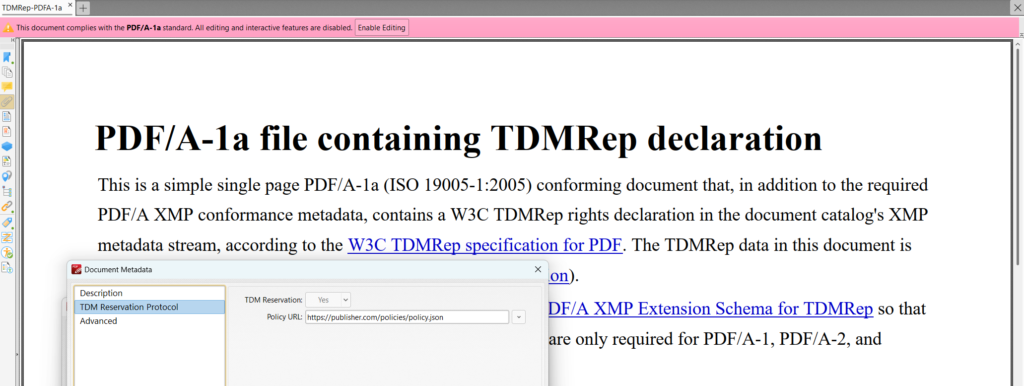
- Unironically, AI-generated documents should explicitly declare their text & data mining rights using TDMRep (while noting the documentation errors related to PDF/A!) so future AI systems know whether to ingest this AI-generated content.
- A C2PA Content Credential should be included, acting as a trust indicator and provably establishing provenance as AI-generated content.

Why are AI-generated PDFs untagged?
Given that AI systems know exactly what they are writing, we have to wonder why AI-generated PDF files are untagged (at least, we are not aware of AI systems that consistently produce tagged PDFs without explicit prompting or custom agents). Why isn’t that the default approach?
Of course, understanding untagged PDF files requires far more tokens than using the tag tree. Could this be the commercial driver that explains why AI-generated PDFs are untagged?
Citations and citeability
It’s right to be cautious of AI hallucinations. Thanks to these market pressures, almost all interactive AI systems now provide “citations” in the form of URLs to back up statements and claims (which, yes, may themselves be hallucinations!).
On the web, HTML content citations are constrained by existing id attributes. We are unaware of current general-purpose AI systems that leverage text fragment identifiers to provide more precise citation locations, instead leaving humans to manually qualify assertions buried within web pages. Although EPUB once included a Canonical Fragment Identifier (CFI), it is no longer part of EPUB 3.3, resulting in the same citability restrictions as HTML.
PDF has, for decades, provided its own well-documented set of fragment identifiers (ISO 32000-2, Annex O and RFC 8118, section 3) supporting highly precise citations - down to the level of a specific page, specific annotation, a destination, or even a rectangular area within a page. AI has no excuse for waving in the general direction of a 1,000-page reference manual or at an oversized engineering or architecture drawing without being far more specific.
An AI-generated PDF may also leverage PDF features to produce more useful output. For example, rendering citations inline in page content makes reuse harder if the user doesn’t want to include citations. PDF markup annotations, on the other hand, can highlight the text and provide a citation or other evidence that can be more easily removed once it is verified - both options provide the evidence behind the AI, but only one enables cleaner reuse. If this PDF is then re-ingested and re-processed by AI, PDF annotations support a threaded “in-reply-to” (IRT) model so each AI iteration could supplement its information, establishing a “custody chain” of information.

When AI-generated PDFs are consumed by AI, ensuring output PDFs include features such as named destinations, embedded files, bookmarks (outlines), and structure elements (part of a Tagged PDF) supports precise citability in the future.
Today, AI is often used to help address accessibility issues by creating Tagged PDFs from untagged or poorly tagged PDF documents, adding alt-text to images, etc., but this is only the first step toward more useful documents.
AI systems can also enhance existing PDFs with markup to improve citability, supplement them with machine-readable data, or add their own markup annotations, resulting in more useful documents for both humans and AI. PDFs’ incremental update capability allows the original PDF to remain unaltered. When re-ingested, such additions or markups might also save tokens and time.
PII in AI-generated documents
Today, people engage with AI for very personal or commercially sensitive reasons. So what happens if the PDF generated by an AI session contains sensitive or personal information (PII), such as medical or financial information? Such PII may be a small scrap of information buried in a wall of AI verbosity, but the consequences can still be severe.
HTML has not formalized redacted content as comprehensively as PDF. HTML pages may use various approaches such as specific Unicode characters (such as “FULL BLOCK" █), replacing text with other text (e.g., “[REDACTED]”), or rendering to a canvas for a more accurate graphical appearance.
PDF 1.7 introduced redaction annotations (ISO 32000-2, 12.5.6.23) to support redaction procedures in sensitive content workflows. Redaction annotations allow users (human or AI agent) to identify content to be removed before the workflow step of actual removal. A PDF file that has been through the full redaction workflow will have no redaction annotations.
If AI-generated PDF documents included redaction annotations marking PII suspects, then a human would (a) become very aware of the presence of PII in their documents, and (b) could review each occurrence and individually decide if the content needed to be redacted or not.

Orchestrating AI - really?
AI vendors have social, ethical, and increasingly, legal obligations to identify AI output while also addressing accessibility. As such, every user shouldn't need to explicitly orchestrate their AI or build complex agent skill files just to generate high-quality, citable Tagged PDF output documents - this should be the standard built-in default capability in every AI system.
Conclusion
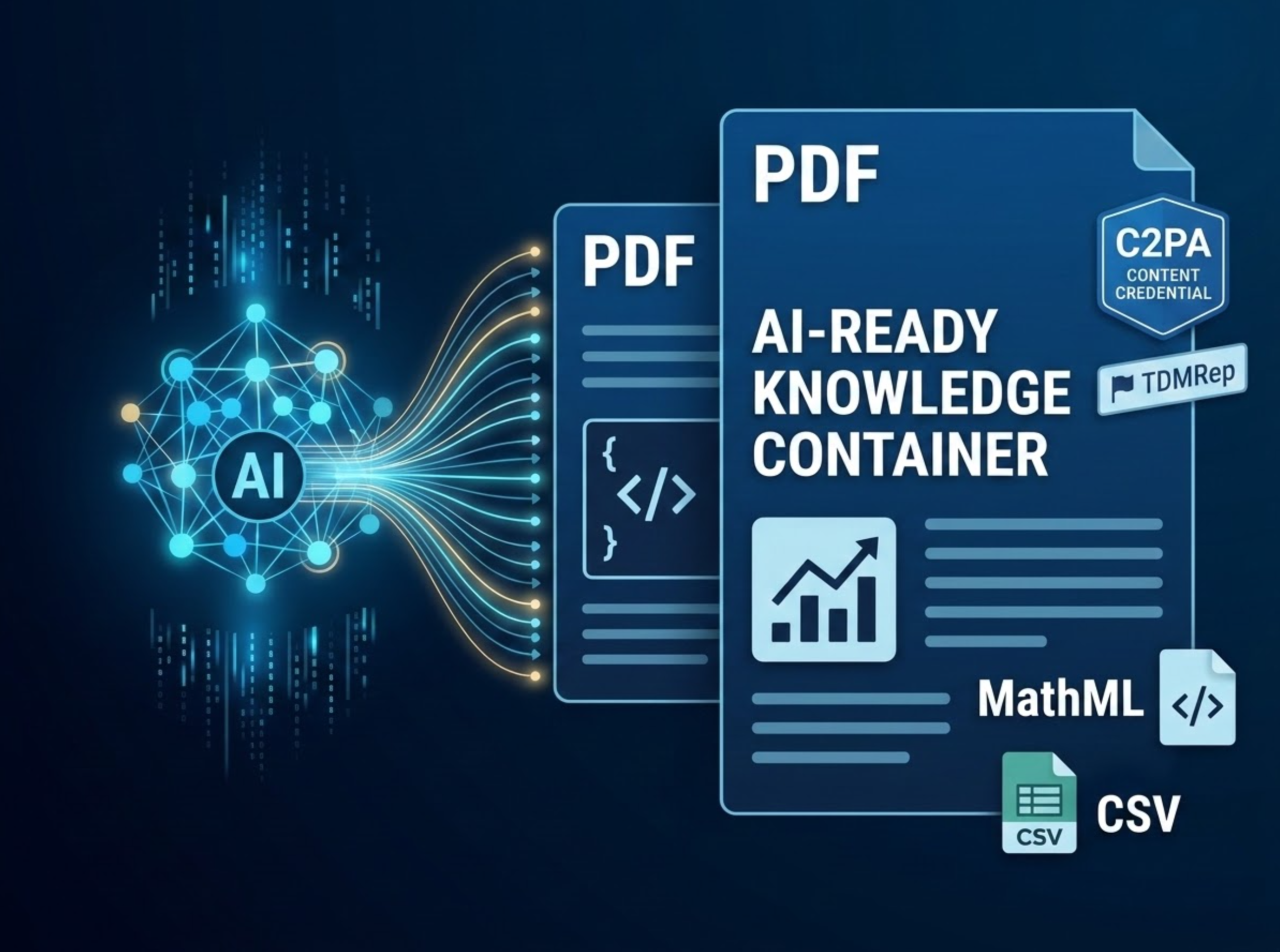
Since the time of stone tablets and papyrus, documents have been “knowledge containers”. In the digital world, document formats such as PDF serve the same purpose.
Instead of treating AI-generated documents as merely renderings (digital papyrus, if you like), AI-generated documents should leverage PDF’s rich capabilities, from semantics to provenance to markup, and more. AI-generated documents should be AI-ready (self-interest!), accurately citable, provenance-aware, rights-aware, privacy-aware, and hybrid reusable knowledge containers accessible to agents and humans alike.
