






OSDC V12 is now available!

Member NewsOctober 1, 2026
Member NewsOctober 1, 2026

About Antenna House, Inc.
The views expressed in this article are those of the author(s) and do not reflect the policies or positions of the PDF Association.
Antenna House OSDC V12.0 Adds PDF/X Output and Expands Office Document Conversion
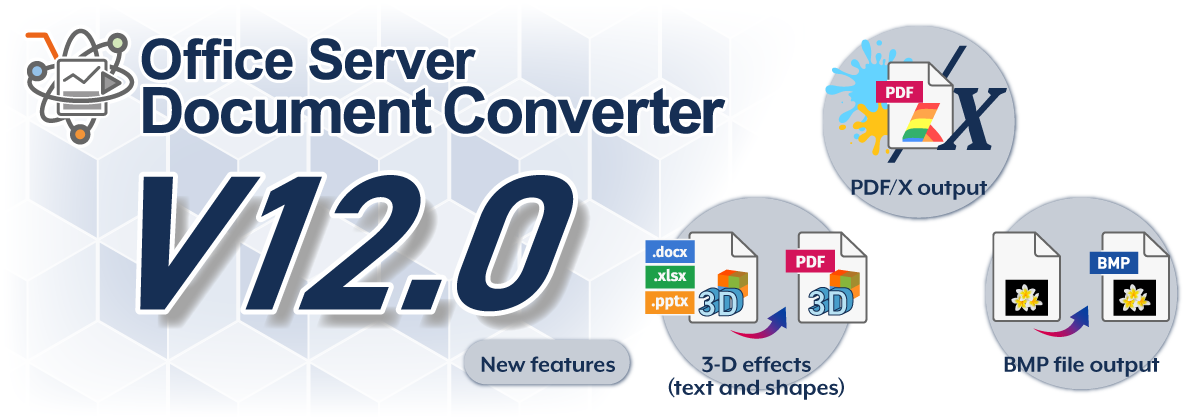
Antenna House Office Server Document Converter (OSDC) V12.0 adds PDF/X output, extending its document conversion capabilities to workflows that require PDF files for print production. The release supports PDF/X-1a, PDF/X-3, PDF/X-4, and PDF/X-4p, alongside improvements to PDF output settings, Microsoft Office document rendering, text encoding detection, and image output.
PDF/X, defined in the ISO 15930 family of standards, establishes requirements for exchanging PDF files intended for printing. Supporting multiple PDF/X formats allows applications to select the format required by the receiving print workflow, including PDF/X-4 workflows that support transparency and color-managed content.
For organizations converting Office documents as part of an automated publishing process, this adds a standards-based print output option to their conversion workflow.
Configurable output intents and PDF settings
The new PDF/X support includes controls for specifying output intents and ICC profiles. Users can select an ICC profile through the -pdfprofile command-line parameter or configure the output intent using the new default-output-intent option, which applies to both PDF/A and PDF/X output.
The embed-std-output-intent option controls ICC profile embedding for applicable PDF/X formats. For PDF/X-4, embedding the output intent’s ICC profile remains mandatory regardless of this setting.
OSDC V12.0 also introduces an error-on-pdfx-fault option to control whether processing continues when a document does not meet PDF/A or PDF/X requirements. This provides a configurable response to conformance problems; continuing processing does not resolve the underlying compliance issue.
Existing PDF/A capabilities receive additional flexibility. Users can now specify the PDF version when producing PDF/A-2a, PDF/A-2b, PDF/A-2u, PDF/A-3a, PDF/A-3b, and PDF/A-3u output.
Other PDF output additions include a transparency option to control conversion of transparency to opacity, and an encrypt-metadata option with the associated -nemd parameter to control metadata encryption when producing encrypted PDFs.
More faithful reproduction of Office documents
OSDC V12.0 adds support for rendering selected 3D effects applied to shapes and text in Word, Excel, and PowerPoint files. Supported settings include depth, lighting source, rotation along the X, Y, and Z axes, perspective, and distance from the base. This helps preserve the intended appearance of titles and graphic elements during conversion.
The feature reproduces supported Office visual effects; it does not add support for converting embedded 3D models. Restrictions also apply to grouped shapes and certain combinations of text effects and shape formatting.
Word DOCX conversion now supports line number output, including numbering settings associated with pages and sections and documents with multiple columns. The -docnonlinenumber parameter allows users to suppress line numbers in the converted output. Junctions between double and triple table borders have also been improved, and the new -psbkm parameter provides a way to limit bookmark output during Word conversion.
For workflows that update table-of-contents page numbers and total page counts, the new conditional-2nd-pass option can avoid unnecessary processing. Previously, using -docpagenumbercorrection always triggered two conversion passes. With the new option enabled, OSDC can skip the second pass when it determines that one is unnecessary. The default preserves the existing two-pass behavior; enabling the check may add a small amount of processing time when a second pass is required.
Excel XLSX conversion gains broader support for displaying form controls. In addition to checkboxes and combo boxes, V12.0 supports buttons, spin buttons, list boxes, option buttons, group boxes, labels, and scroll bars. These enhancements concern the controls’ visual representation, with some differences in text direction and formatting still possible.
External hyperlinks in Excel documents are also supported, including links to websites, files, folders, and email addresses.
Expanded text and graphics support
Text conversion receives two improvements aimed at reducing encoding-related errors. The new preferred-encoding option allows users to prioritize UTF-8 or Shift_JIS during encoding detection, while automatic detection remains the default. When a file contains a Byte Order Mark (BOM), OSDC now gives that marker the highest priority when determining the encoding.
Image output expands with the addition of BMP, alongside the existing PNG, JPEG, and TIFF formats. BMP output can be selected with the command-line parameter -p @BMP.
OSDC V12.0 also adds EMF+ (Enhanced Metafile Format Plus) rendering alongside existing EMF support. Current limitations include solid-color text fills only, restricted support for shape gradients, and no image tiling.
Additional controls and maintenance updates
Several further changes give developers more control over conversion behavior:
- Reverse page output: The new
-prevpparameter outputs pages in reverse order. - Watermark opacity: The
watermark-opacityoption and-wmarkopacityparameter now accept percentage values or values on a 0-to-1 scale. Full opacity is represented by 100% or 1. A value of zero remains invalid but now leaves the opacity unchanged instead of resetting it to the previous default of 0.2. - .NET interface: The interface moves from .NET 8 to .NET 10.
- Library updates: OpenSSL is updated to 3.6.4, Skia to m149, and libtiff to 4.7.2 as part of the release’s library security maintenance.
The release also corrects Word DOC conversion issues involving line spacing when font names differ across environments and unwanted blank space following pages containing footnotes. An Excel conversion error involving the -xlspaper parameter with graph: sheet: specifications has also been corrected.

Founded in 1984, Antenna House, Inc. is a global software company that works to make your documentation development and processing easier every single day. We specialize in providing enterprise solutions for high volume, automated document formatting and conversion needs. Our signature product, AH Formatter, is based on the W3C recommendations…
Read more