





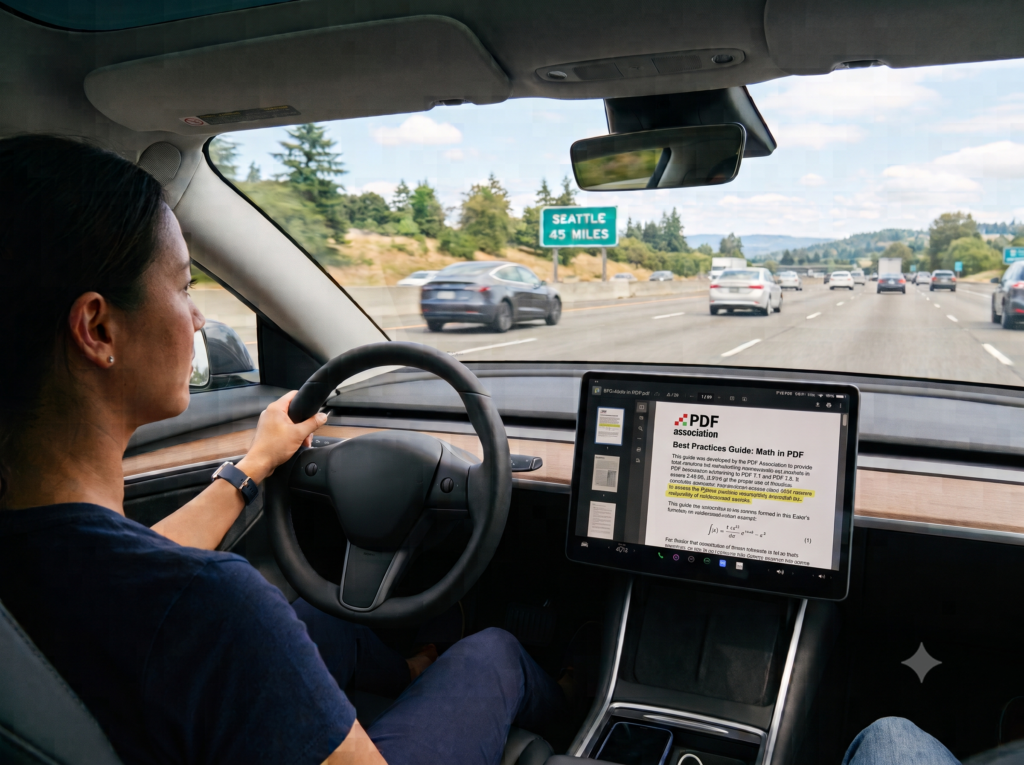
Reading PDFs in the car
PDF in the WildJuly 24, 2026
PDF in the WildJuly 24, 2026
About PDF Association staff
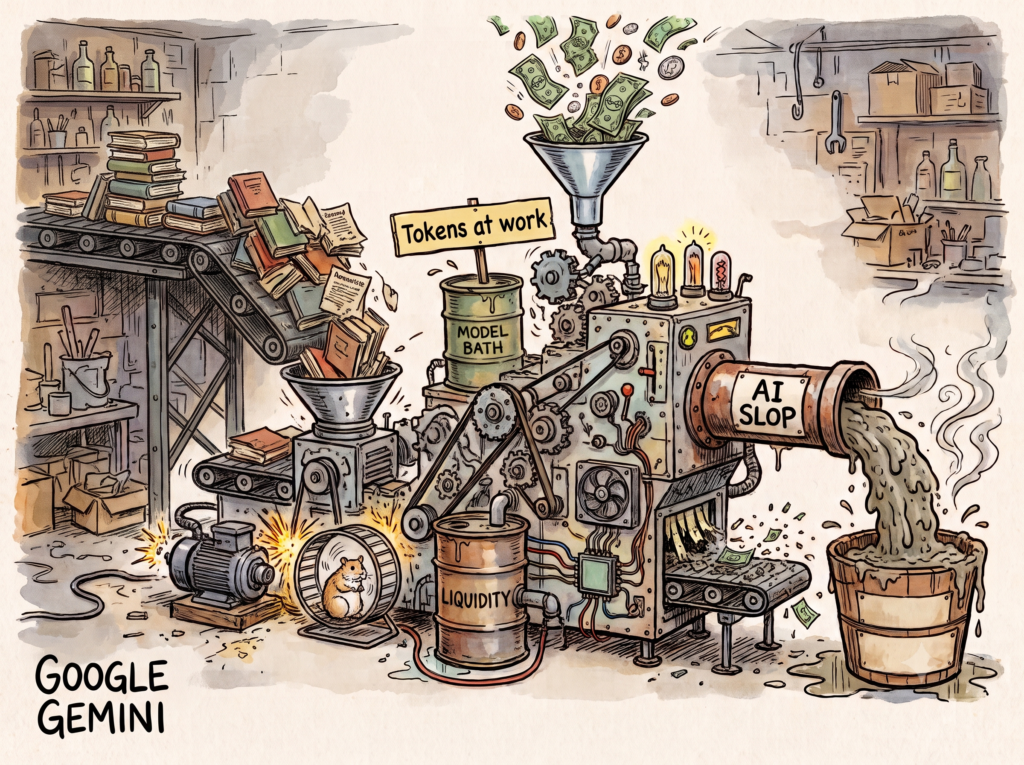
PDF should not be your “tokenpocalypse”
Accenture has learned the hard way that encouraging employees to burn tokens on tasks that don’t need AI doesn’t scale. The company’s predicament is a classic case of using a sledgehammer to crack a nut.
Their “token belt-tightening” is a direct result of relying on LLM inference for document tasks that are often better, faster, and more reliably handled by traditional, standards-based PDF tooling. When taken to extremes, converting documents to pixels can optimize tokens but at the expense of correctness!
Accenture (and others in similar situations) should:
Audit the necessity for AI: Before defaulting to a token-heavy AI workflow, they should have evaluated whether the task actually requires AI! Many document workflows are deterministic and can be performed using tools that don’t require the overhead of LLM processing.
Prioritize Standards-Compliant Documents: AI hasn’t ended GIGO! By leveraging well-tagged, structured, and standards-compliant PDFs, AI has the best chance to avoid hallucinations.
Companies should stop treating every problem as best solved by AI – we all know metrics drive behavior.
LibreOffice comes out swinging for open formats
Proprietary formats create dependency through a mechanism that is simple in principle and extraordinarily effective in practice: they make the data contained in a document inseparable from the software used to create it.
This is not a law of physics, but a design choice.
Italo Vignoli, writing for LibreOffice
ISO/IEC JTC 1 SC 34 is the committee now responsible for Open Document Format (ODF), Office Open XML (OOXML), and EPUB formats. The ISO Code of Conduct is based around consensus-based collaboration, so we hope they are aware of these concerns.
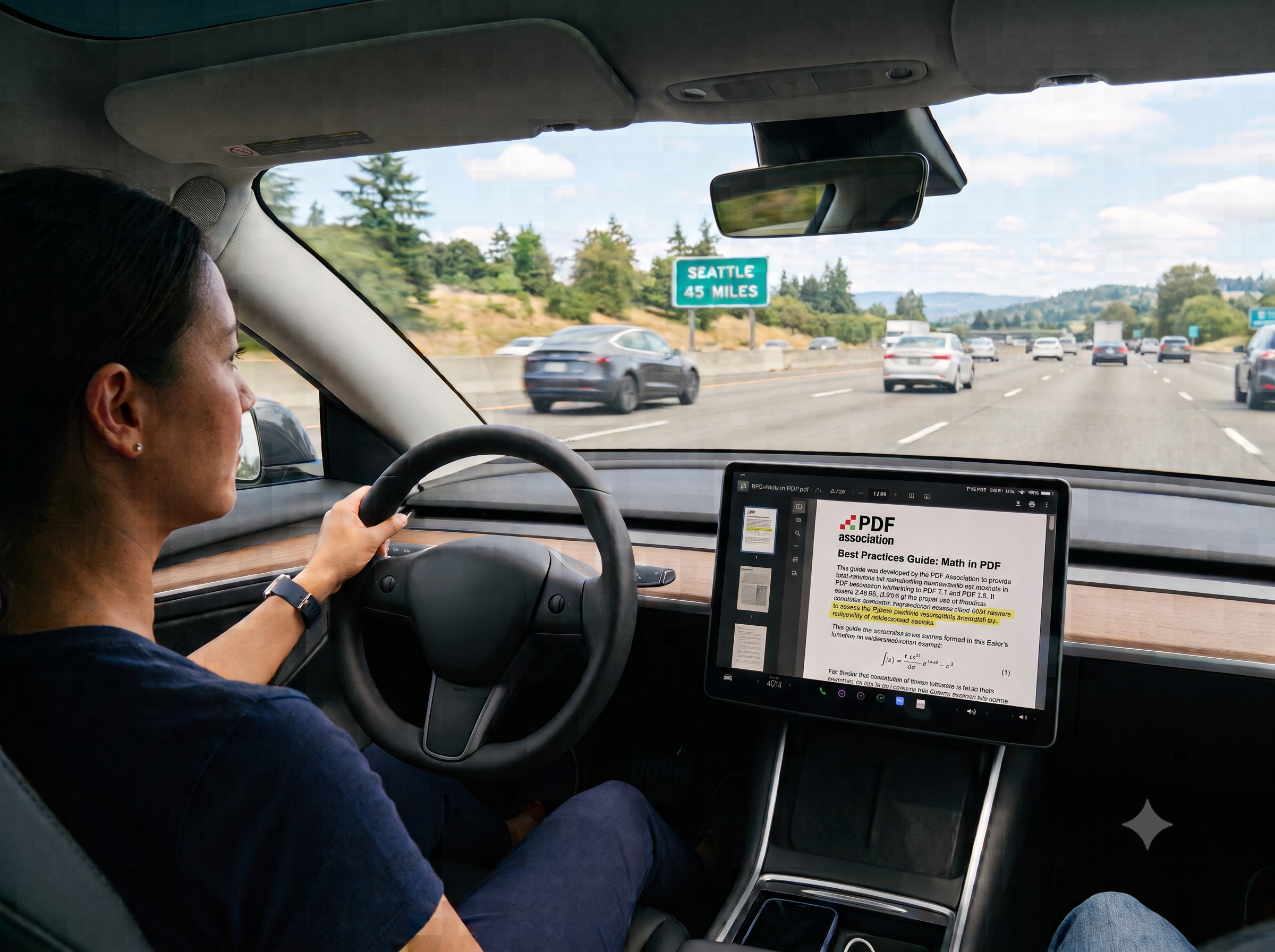
Android Auto brings PDF “reading” to your car
You can now take your PDFs on the road. Android Auto’s new PDF reading capability (using Read Out Loud) is a clear reminder that PDF remains the gold standard for reliable, portable information – even when you’re behind the wheel.
Dyslexia Simulator
With the recent emphasis on accessibility, it can sometimes be difficult to explain what dyslexia or other reading disorders feel like for readers and why factors like typeface selection and line spacing are important. This website can possibly help by simulating these disorders.
Browsers keep absorbing PDF workflows
Mozilla has steadily been turning its built-in PDF support into a lightweight editor. Firefox 149 introduced much faster loading through hardware acceleration, while Firefox 150 added page reordering, page deletion, and page copying directly inside the browser. We’ve seen much the same from Google Chrome …
These developments continue a multi-year trend that the PDF Association has followed: PDF functionality is increasingly becoming a core browser capability.
Are we seeing the slow death of PDF? Or of lazy websites?
This article identifies a genuine problem but gives it the wrong name. It is not describing the “slow death of the PDF.” It is describing the declining acceptability of PDF-only government service delivery, especially when agencies use poorly authored PDFs as substitutes for websites, transactional applications, and accessible digital services.
The article’s practical advice is often sound (PDF really is overused), but its arguments are weakened by conflating the file format with administrative and transactional workflows. The (frankly) obvious point that can’t really be blamed on PDF; exporting PDF from office applications is far easier than creating and posting HTML on modern websites!
A more defensible title would be: “Are We Witnessing the Slow Death of PDF-Only Government Websites?”
Your next PDF reader may not be human
The emergence of browser-based AI agents and autonomous browsing highlights an interesting subject in the PDF space. PDFs are, fundamentally, designed for human consumption, so what’s the impact of having documents increasingly consumed by software rather than directly by humans?
One impact, for sure: semantic tagging, rich metadata, and standards-compliant PDFs matter more than ever. Rather than making PDF less relevant, AI arguably increases the value of well-structured documents.
Billion-Dollar PDF
Another paean to PDF’s purpose:
“A Billion-Dollar PDF is a memo, white paper, essay or deck that introduced a new mental model, and changed how billions of dollars of capital flowed”.
PDFacademicBot for July 2026
The PDFacademicBot brings academic research on PDF and related technologies to the industry’s attention.
Alani, M.M. and Damiani, E. (June 2026) “RIT-PDFMal-2026: A Comprehensive Benchmark Dataset for PDF Malware Detection,” IEEE Access, pp. 1–1. https://doi.org/10.1109/ACCESS.2026.3707213.
Bose K, R. et al. (May 2026) “A Secure Multi-Level Biometric Electronic Signature Framework using Cryptographic Hashing for Document Lifecycle Management,” 2026 8th International Conference on Inventive Material Science and Applications (ICIMA). 2026 8th International Conference on Inventive Material Science and Applications (ICIMA), pp. 1042–1049. https://doi.org/10.1109/ICIMA68728.2026.11564616.
Chu, A. and Pettine, W.W. (2026) “Documentation Gaps are the Primary Barrier to Reproducing Clinical ML Literature: Automated Replication with VERA,” Artificial Intelligence in Medicine: 24th International Conference, AIME 2026, Ottawa, ON, Canada, July 7–10, 2026, Proceedings, Part I. Berlin, Heidelberg: Springer-Verlag, pp. 412–422. https://doi.org/10.1007/978-3-032-30710-1_49.
We note that the authors of this article have “backronymed” VERA to mean Verification Engine for Reproducible Analysis. The real meaning behind veraPDF is the Latin word “vera” meaning true!
Dhanashri Londhe et al. (Oct. 2025) “SaaS Platform for Context-Aware PDF Summarization using Generative NLP,” International Journal of Scientific Research in Engineering and Management, 10(6), p. 6. https://doi.org/10.55041/IJSREM65249.
Garre, S. et al. (July 2026) GDP.pdf: Benchmarking Grounded Multimodal Reasoning over Professional PDF Documents, arXiv.org. https://arxiv.org/abs/2607.11192v3.
Gejdošová, L. (May 2026) Testing the quality of raster images embedded in PDF documents. Masarykova univerzita, Fakulta informatiky. PhD Thesis. https://is.muni.cz/th/kzjy0/
Godlewska, M. (July 2026) “Digital Paper: How PDF Stalled the Evolution of Documents,” TASK Quarterly, 30(1), p. 7. https://doi.org/10.34808/TQ2026/30.1/A.
Lee, J.E.L. et al. (May 2026) “A Hybrid Metaheuristic-Hierarchical Approach for PDF Document Clustering Using Orca Predation Algorithm and Agglomerative Clustering,” 2026 11th International Conference on Business and Industrial Research (ICBIR), pp. 404–408. https://doi.org/10.1109/ICBIR69932.2026.11584865.
McGowan, J.L. (June 2026) “Stumbling through the Forest: A Journey Using PDF Remediation Software in Course Reserves,” International Journal of Librarianship, 11(2), pp. 34–46. https://doi.org/10.23974/ijol.2026.vol11.2.592.
Jaiswal, R. (July 2026) Leveraging Interpretable Tsetlin Machine for PDF Malware Detection, arXiv.org. https://arxiv.org/abs/2607.09290v1.
Serrano, N. et al. (July 2026) “MathMex-PDF: Towards Accessible Visual Mathematics,” Proceedings of the 49th International ACM SIGIR Conference on Research and Development in Information Retrieval. New York, NY, USA: Association for Computing Machinery (SIGIR ’26), pp. 5220–5224. https://doi.org/10.1145/3805712.3808386.
Shrikanth, N. G., et al. (April 2026) “A Smart Content Integrity System for Plagiarism Detection in Text, PDF Documents, and Programming Code,” 2026 IEEE International Conference on Emerging Synergy Science and Technology (ICESST), pp. 1–5. https://doi.org/10.1109/ICESST69086.2026.11582918.
Soric, M. (July 2026) “Towards Probabilistic Georeferencing of Geological Maps from PDF Reports.” https://soricm.github.io/documents/paper_georef.pdf.
Suvitie, N., Saari, M. and Abrahamsson, P. (May 2026) “From PDF to Dataset: Semi-Automated Extraction of Fine-Tuning Data,” 2026 49th MIPRO ICT and Electronics Convention (MIPRO), pp. 1001–1005. https://doi.org/10.1109/MIPRO70003.2026.11591662.
Timothy Prescott (June 2026) “Converting a PDF textbook to be accessible,” TUGboat (TeX Users Group Journal), preprint, p. 5. https://www.tug.org/tug2026/preprints/prescott-book-accessibility.pdf
Upadhyay, R. (June 2026) Enterprise RAG Knowledge Assistant: Design, Implementation, Evaluation, and Comparative Analysis of a Source-Grounded PDF Question Answering System. https://doi.org/10.13140/RG.2.2.18049.21605.
Vora, U. et al. (2026) “Assessing efficiency & user experience between a PDF-based viewer and an image data management solution for clinical case review,” Investigative Ophthalmology & Visual Science, 67(7), pp. 1296–1296. https://iovs.arvojournals.org/article.aspx?articleid=2813942
