


MathML in PDF takes off
PDF in the WildNovember 17, 2026

PDF in the WildNovember 17, 2026

About PDF Association staff
Firefox v160 now exports HTML to PDF with MathML
Although we’re not happy with the tagging overall, who predicted that a web browser would create tagged PDF files, including accessible math, before many other authoring software packages!
And yes, in the release notes for the latest version of FireFox we find..
“Pages saved as PDF now make mathematical content (MathML) accessible to assistive technology such as screen readers.”
We tested using a Mozilla MathML example page. The math support is great!
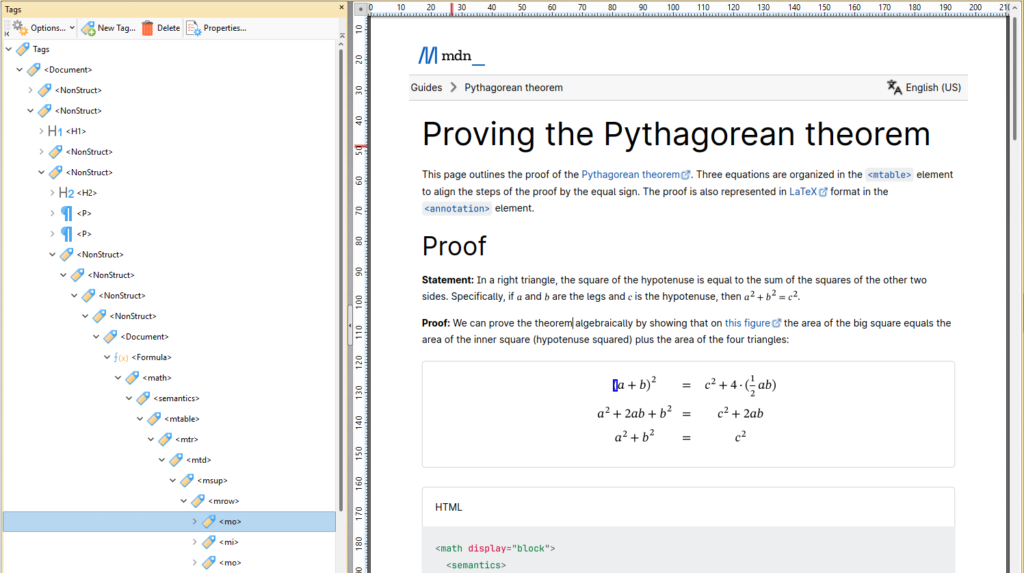
We just wish the output in general was:
- Correctly versioned as PDF 2.0 and not PDF 1.4, as it uses the PDF 2.0 Namespace feature for math as well as other features introduced since PDF 1.4.
- Used other basic features of PDF, such as compressed cross-reference streams and object streams, and the removal of long-deprecated features, resulting in much smaller files.
- Was available via the “Save Page As…” menu, not just the “Print…” option(!)
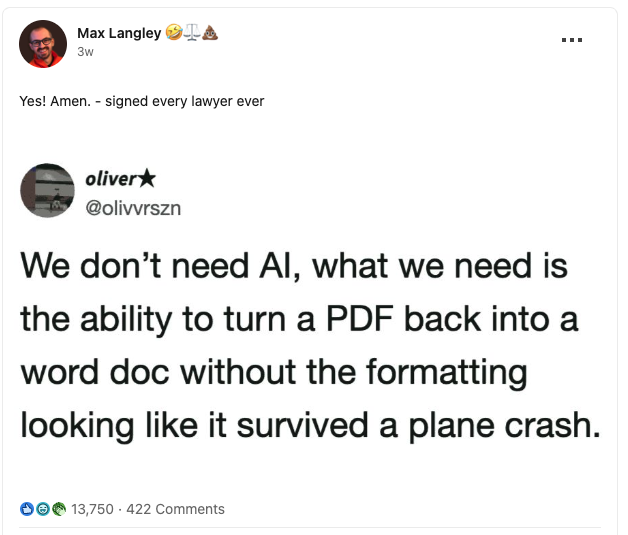
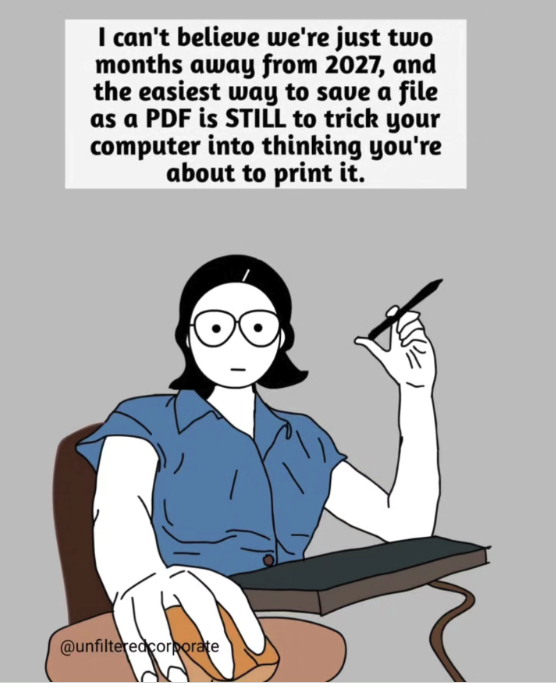
What AIs could do for documents
Peter Wyatt offers his thoughts about AI and documents in a recent post, but some of those ideas are fancy. What do users already know that they need? Sometimes the answers are pretty simple…
Agentic Print Camp
How can (or will) AI contribute to graphic art prepress workflows that historically have relied on PDF/X, preflighting, and expertise in color management?
That’s the subject of a new series of unconferences coming in 2027 to cities across the US.
Gotenburg adopts PDF 2.0
The latest 9.0.0 release of the open-source Gotenburg project adds support for PDF 2.0, PDF/UA-2, WTPDF, combining PDF/A and PDF/UA, and more. It has replaced multiple open-source libraries with its own Go-based “litho” PDF engine with the motto “one PDF engine, real conformance”.
We love this motto!
138 “OCR and PDF” parsers… but what about Tagged PDF!
HackerNoon’s roundup of open-source OCR and document parsing projects from https://textmining.tech/ provides a snapshot of developers’ enthusiasm for extracting information from PDFs. We were excited to read it… until we noticed that its introduction frames PDF processing solely as turning pixels and layout into text, neglecting PDF’s ability to carry explicit semantic structure.
Ranked by GitHub stars, the list features a variety of approaches to the problem, yet this extensive catalogue manages to omit any discussion of Tagged PDF.
Certainly, scanned documents and untagged PDFs require other approaches. But a survey of PDF parsing tools should ask whether they use the structure already available in tagged PDF documents.
OPF video of recent Arlington veraPDF webinar
If you missed Boris Doubrov’s talk about the Arlington PDF Model in September for the Open Preservation Foundation, you can now watch it on YouTube (41 minutes).
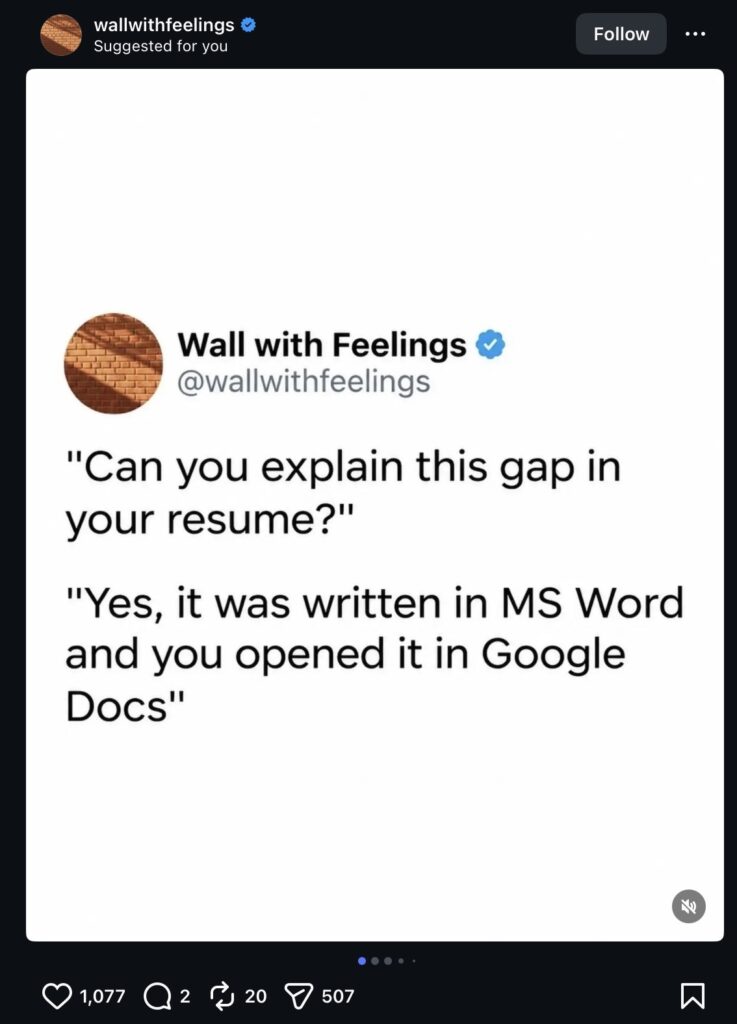
PDF delivers the reliable interoperability other formats lack
File this under “Why we need PDF”...
You can’t know what software your recipient may use (and this is increasingly true in the AI era).
But with PDF, you don’t have to know!
PDFacademicBot for November 2026
The PDFacademicBot brings academic research on PDF and related technologies to the industry’s attention.
Alani, M.M. and Damiani, E. (Sept. 2026) “Network-Based Detection of Evasive Pdf Malware in Medical Documents Using Explainable Stacked Ensemble of Deep Neural Networks,” 2026 International Conference on Cybersecurity and AI-Based Systems (Cyber-AI), pp. 111–117. https://doi.org/10.1109/Cyber-AI70573.2026.11755210.
Chatterjee, Pronobesh (Oct. 2026) “A Modular Architecture for Accessible Digital Reading Using Interactive PDF Parsing, Page-Turn Rendering, and a Reading-Assistant Widget,” ResearchGate, p. 5. https://doi.org/10.13140/RG.2.2.26805.03048.
Firdaus, N., A’la, F.Y. and Supriyadi, A. (Sept. 2026) “Hybrid Retrieval-Augmented Question Answering for PDF Resumes Using BERT-NER and Ontology-Based Context Enrichment,” 2026 International Conference on Data Science and Its Applications (ICoDSA), pp. 271–276. https://doi.org/10.1109/ICoDSA71861.2026.11754628.
Hansel, C.A. et al. (2026) “Accessibility Revolution: Cross-Disciplinary Strategies for Accessible Design,” Advancing Accessibility, pp. 49–68. https://edtechbooks.s3.us-west-2.amazonaws.com/pdfs/2204/23921.pdf.
Jadhav, D. et al. (2026) “A Voice-Assisted PDF System with RAG: A Comprehensive Technique to Interact with PDFs,” Advancements in Intelligent Systems for Communication, Energy, and Big Data. CRC Press. https://www.taylorfrancis.com/chapters/edit/10.1201/9781042040476-49/voice-assisted-pdf-system-rag-comprehensive-technique-interact-pdfs-dhiraj-jadhav-deepak-yash-deshmukh-vrushabh-patil-dewanshu-gakhare
Kiroshka, K. and Elze, T. (Oct. 2026) “import_pentacam: Open-Source OCR Recovery of Corneal Tomography Measurements From Pentacam DICOM, PDF, and Image Archives,” Translational Vision Science & Technology, 15(10), p. 46. https://doi.org/10.1167/tvst.15.10.46.
Liu, G. et al. (2026) “PageRAG-H: Page-Level Visual Retrieval-Augmented Generation with Grounded Reasoning Harness for Multilingual PDF Question Answering,” Proceedings of the 34th ACM International Conference on Multimedia. New York, NY, USA: Association for Computing Machinery (MM ’26), pp. 17620–17626. https://doi.org/10.1145/3767308.3837713.
Patel, S. (Oct. 2026) “Cheap First, Ask the LLM Later? Cost and Accuracy of Rule-Based, Native-PDF, and Text-Based LLM Extraction of Syllabus Deadlines.” Preprints. https://doi.org/10.20944/preprints202610.2704.v1.
Power, C. and Vasquez III, E. (Oct. 2026) ATS Hub Field Note — Exploring AI Tools for Accessible Scientific Documents. Digital Promise. https://doi.org/10.51388/20.500.12265/326.
Pushchinskyi, Andrii (Oct. 2026) “Exporting Revit Views and Sheets to Layered DXF and PDF While Preserving Draw Order,” Defensive Publications Series [Preprint]. Technical Disclosure Commons. https://www.tdcommons.org/dpubs_series/12470.
Sahu, P.K., Singh, B. and Bharadwaj, N.K. (Dec. 2026) “SCAR: Semantic carving of modern PDFs with cross-reference-stream recovery and anchored bi-fragment Stream Repair,” Forensic Science International: Digital Investigation, 59, p. 302237. https://doi.org/10.1016/j.fsidi.2026.302237.
Yin, A., Arcos, K. and Branham, S.M. (Oct. 2026) “What It Really Takes to Make an Academic PDF Accessible,” Proceedings of the 28th International ACM SIGACCESS Conference on Computers and Accessibility. New York, NY, USA: Association for Computing Machinery (ASSETS ’26), pp. 1–7. https://doi.org/10.1145/3797867.3832768.
Yousefi, S., Najjar-Ghabel, S. and Ali, A.A. (Sept. 2026) “SHAP-PDFStack: An Explainable Hybrid Stacking Model with Latent Feature Learning for Malicious PDF Detection,” 2026 10th Scientific School Dynamics of Complex Networks and their Applications (DCNA), pp. 1–6. https://doi.org/10.1109/DCNA72004.2026.11733463.
