






Declaring WCAG compliance in PDF
ArticleJuly 2, 2026
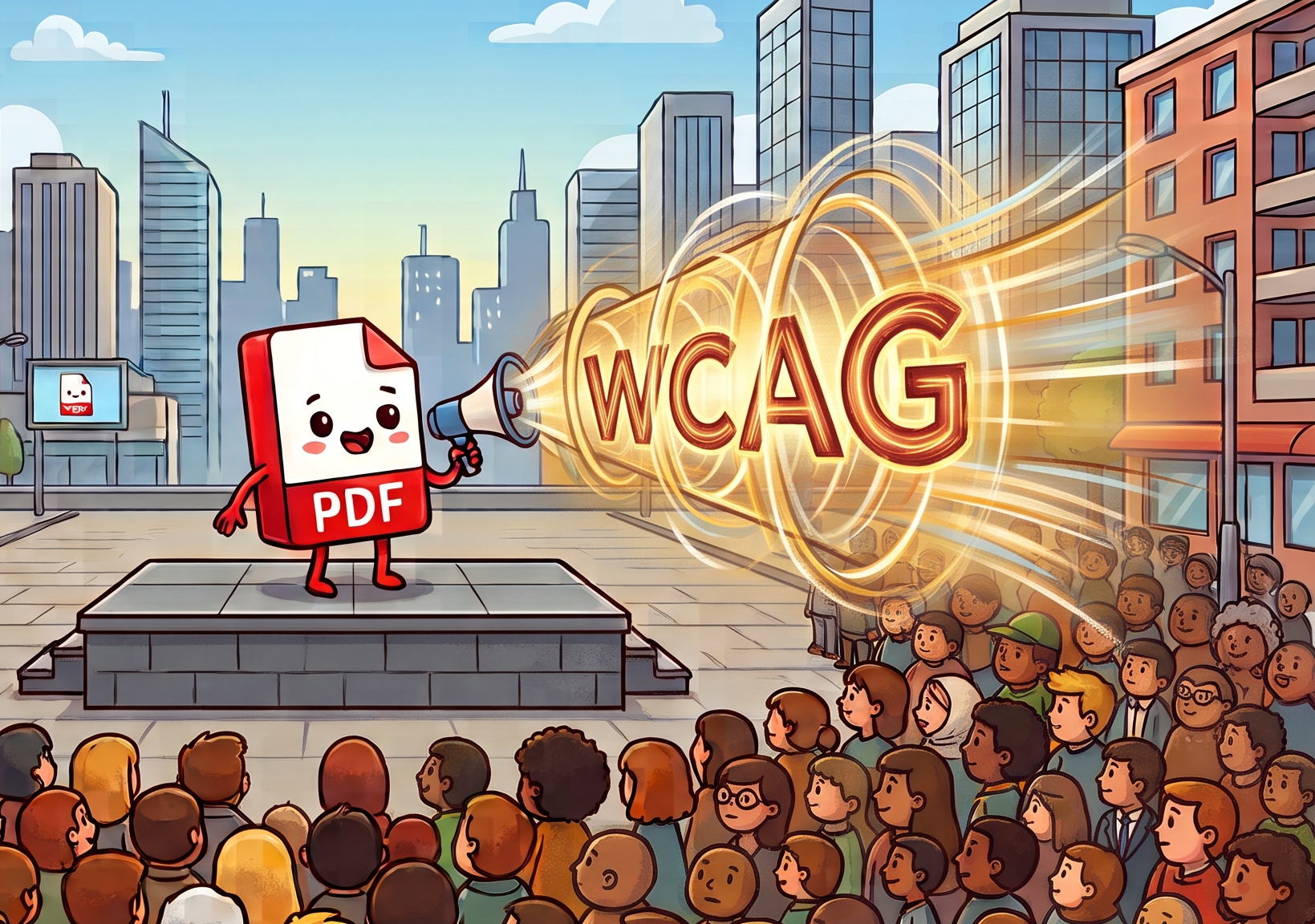

ArticleJuly 2, 2026

About Duff Johnson, PDF Association
Creating accessible digital content is no longer just best practice; in many areas it’s a legal necessity.
BUSINESS NOTE
Adding WCAG conformance statements to PDF documents using PDF Declarations provides standardized accountability for accessible documents.
BUSINESS NOTE
Adding WCAG conformance statements to PDF documents using PDF Declarations provides standardized accountability for accessible documents.
W3C’s Web Content Accessibility Guidelines (WCAG) define the terms and objectives of digital accessibility and are referenced in laws worldwide. Although written for the web context, WCAG’s benchmarks are commonly used to assess all forms of digital content. Accessibility assistants in modern office products leverage WCAG to provide feedback to authors, helping ensure their content is accessible in whatever exported format they choose.
Applying some of WCAG’s web-oriented rules to the fixed-layout world of PDF documents can be complex. While ISO 14289 (PDF/UA) provides the technical requirements for accessibility, it intentionally does not mandate many content-related aspects. Neither PDF/UA nor WCAG specifies an explicit means of communicating a PDF document's accessibility properties with respect to WCAG’s success criteria.
Enter the PDF Declarations specification. Developed by the PDF Association, this simple mechanism offers a standardized way to embed conformance statements, including explicit accessibility claims, directly within a PDF file. The PDF Association's PDF Declarations for WCAG conformance comply with the terms of WCAG’s conformance claim model for web pages.
What are PDF Declarations?
A PDF Declaration consists of machine-readable XMP metadata embedded alongside the document’s main metadata. Declarations provide a means of explicitly stating conformance to other standards, the exact scope of that conformance, and optionally, the testing methodologies used to verify it. WCAG conformance can be easily expressed with an appropriate PDF Declaration.
For organizations required to meet WCAG standards, PDF Declarations address a critical communication gap by establishing and documenting the author's or remediator’s claim that the document has been vetted for compliance with applicable WCAG success criteria.
How PDF Declarations support WCAG conformance
- Labeling: A PDF Declaration of conformance to WCAG is visible to anyone using a PDF viewer that supports PDF’s XMP metadata.
- Persistent: PDF Declarations are incorporated into each PDF file, and therefore are available wherever the PDF is viewed, without "sidecar" files or separate conformance statements.
- Granular: A declaration doesn’t just say a document is "accessible." It can state, for example, that the file conforms to WCAG 2.1 Level AA.
- Extendable: additional PDF Declarations can also be included, such as to the PDF Association’s Well-Tagged PDF specification, national accessibility legislation, or any other relevant standard.
- Machine-Readable: Automated accessibility checkers and corporate ingestion systems can instantly read the Declaration and use it to make decisions in automated compliance workflows, allowing organizations to automatically screen thousands of individual PDFs for claims of legal compliance.
- ISO Standards Compliant: the use of XMP metadata with PDF Declarations is compatible with all versions of PDF (ISO 32000) and all ISO standardized subsets for PDF, such as PDF/UA (ISO 14289) and PDF/A (ISO 19005). XMP itself is also formalized as ISO 16684.
- Long-term Archival: see the PDF Association’s Best Practice Guide on conforming to both PDF/A and PDF/UA, and its free XMP Extension Schema resources.
- Trust: PDF’s digital signature features allow authors to “lock” PDF files to ensure (among other outcomes) that the accessibility features and any PDF Declarations cannot be removed.
Adding Declarations
Integrating PDF Declarations into your workflow is straightforward (assuming your PDF editing software can modify XMP data in the PDF). Using the specifications hosted at pdfa.org/declarations, developers and accessibility professionals can generate a standardized XMP fragment (an example is provided). This data includes a conformsTo property indicating the specific WCAG version and level, the date of the claim, and metadata about the authoring tool or auditor. This data is merged into the PDF document’s XMP metadata stream.
PDF Declarations are extensible and may be self-made. Although it is not necessary to inform the PDF Association about all new PDF Declarations, government agencies and others defining their own standards or other requirements are welcome to contact the PDF Association to request that we recognize a new PDF Declaration.
As digital accessibility regulations tighten globally, relying on guesswork is no longer an option. PDF Declarations provide the clarity, structure, and accountability needed to bridge the gap between static documents and WCAG standards, ensuring digital content is truly open to everyone.
Image credit: Google Gemini
