




New Best Practice Guide for Mathematical Content in PDF
PDF Association newsApril 21, 2026
PDF Association newsApril 21, 2026
About PDF Association staff
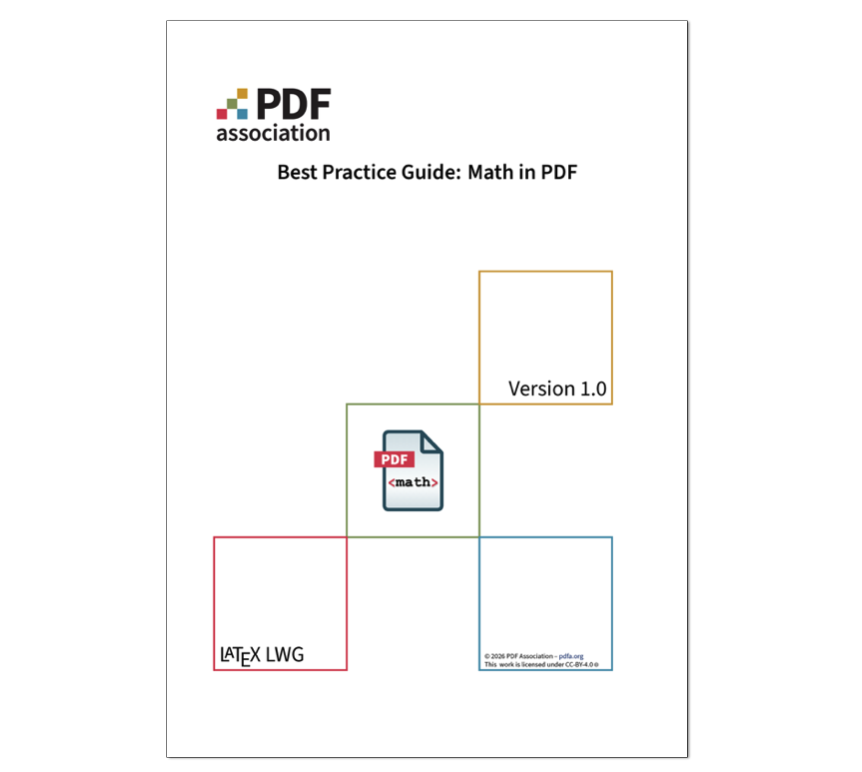
The PDF Association has released the first edition of the Best Practice Guide: Math in PDF. This guide, developed by the LaTeX Project Liaison Working Group, provides critical recommendations for authors and publishers to ensure complex mathematical and STEM content meets accessibility requirements and assistive technology users' needs.
 As technical documents often include sophisticated mathematical formulas, the need for standardized, accessible representations is clear. The new Best Practice Guide addresses this by providing clear guidance on publishing accessible STEM content using MathML syntax within Tagged PDF.
A central theme of the guide is a strong recommendation to use PDF 2.0. Unlike its predecessor, PDF 2.0 natively includes MathML as a standardized namespace and leverages Associated Files (AF) in support of accessibility. These features provide a standardized mechanism for embedding MathML and LaTeX representations as supplements to the visual PDF content, significantly improving the experience for users relying on assistive technology.
“To fully benefit from the accessibility features of PDF, we strongly recommend that documents with mathematical content comply with PDF/UA-2 and WTPDF (Well-Tagged PDF),” the guide notes. The PDF Association further advises against the older PDF/UA-1 standard for math-heavy documents, as PDF 1.7 and PDF/UA-1 rely on inferior alternative text descriptions rather than semantic MathML tagging.
Technical Highlights and Innovation
The guide offers detailed technical instructions on several fronts:
- Guidance on using the MathML Core specification for better browser and processor compatibility.
- Establishes clear rules on how processors should handle multiple representations, recommending that MathML structure elements take precedence over alternative text (Alt) entries.
- Provides detailed examples of using "intent" attributes from MathML4 to improve how assistive technologies read complex notations, such as distinguishing between a "mean of x" and a "complex conjugate of x".
The guide also offers guidance regarding markup of special mathematical graphics (like square root symbols) to ensure they do not interfere with semantic reading orders.
Leading by Example

In a demonstration of the standards it promotes, the guide itself is published as a PDF 2.0 document that complies with WTPDF, PDF/UA-2, and the PDF/A-4f long-term archival standard. It even utilizes an associated CSS file to ensure superior MathML rendering in HTML derived from the PDF.
The Best Practice Guide: Math in PDF is available now under a Creative Commons Attribution 4.0 International License.
Read more about recent advances in delivering accessible STEM content in PDF.
