





Benchmarking AI for documents? Only styled text – what about annotations?
PDF in the WildOctober 23, 2026
PDF in the WildOctober 23, 2026

About PDF Association staff
“Track changes” formatting in PDF… but it's not markup annotations
At first glance, we thought this benchmark of AI document processing might be evaluating AI parser processing of PDFs’ review and markup annotation capabilities. However, on closer examination, this is not what is being evaluated - it is simply visual formatting of in-page content styled with a word processor “track changes” feature.

Once again, it’s disappointing that such useful, widely used PDF capabilities are invisible to AI.
Turning research papers into agents
In past PDF in the Wild editions, we’ve covered various suggestions disparaging PDF (really, scholarly publishing practices) as the basis for scholarly publications in the age of AI. However, Nature recently published “Reimagining research papers as interactive and reliable AI agents” which can convert research papers into artificial intelligence (AI) agents:
“Paper2Agent addresses this challenge by converting a paper into an AI agent that functions as a virtual corresponding author, exposing its manuscript, supplementary materials, datasets, code and workflows as active, agent-native knowledge rather than static text. It analyses the paper and codebase using multiple agents to construct a model context protocol (MCP) server, then generates and runs tests to refine and increase robustness of the MCP. These paper MCPs can be connected to a chat agent (such as Claude Code) to carry out complex scientific queries through natural language while invoking tools and workflows from the paper.”
As reported by IEEE Spectrum, this far less disruptive approach allows authors (and/or publishers!) to check the completeness of papers:
“When the system gets stuck, it can expose missing information, errors in the code, or discrepancies between the paper and its implementation—problems that might otherwise go unnoticed. As Zou puts it: “Agentification itself is a useful certificate that says, ‘This work is relatively complete and well documented.’”
PDF vendor does Brotli (industry extension) and JPEG XL
A Reddit thread reports on the adoption of both JPEG XL and Brotli support. While Brotli support in PDF is finalized and fully documented, JPEG XL support is not.
While it is good to see rapid adoption of the new technologies that will be integrated into a future version of PDF, many of the advanced capabilities of JPEG XL are still under investigation by the PDF Association’s Imaging Model TWG to ensure smooth integration and reliable document appearance for overlapping content, advanced blending, and many other existing PDF features. Our initial testing with the official libjxl conformance test suite showed limited JPEG XL support, with RGB-based SDR display only.
A brief history of markup languages from ISO/IEC JTC 1/SC 34
Our liaison to ISO/IEC JTC 1/SC 34, “Document description and processing languages”, monitors work to ensure that PDF remains aligned with the electronic document formats EPUB, OOXML, and ODF that fall under ISO/IEC JTC 1/SC 34’s scope. Through this liaison, we found their web page, which offers an interesting history lesson on some of the earliest markup “languages,” starting in the mid-1960s with names that may be unfamiliar to some: RUNOFF, GenCode, and ODA (Office Document Architecture).
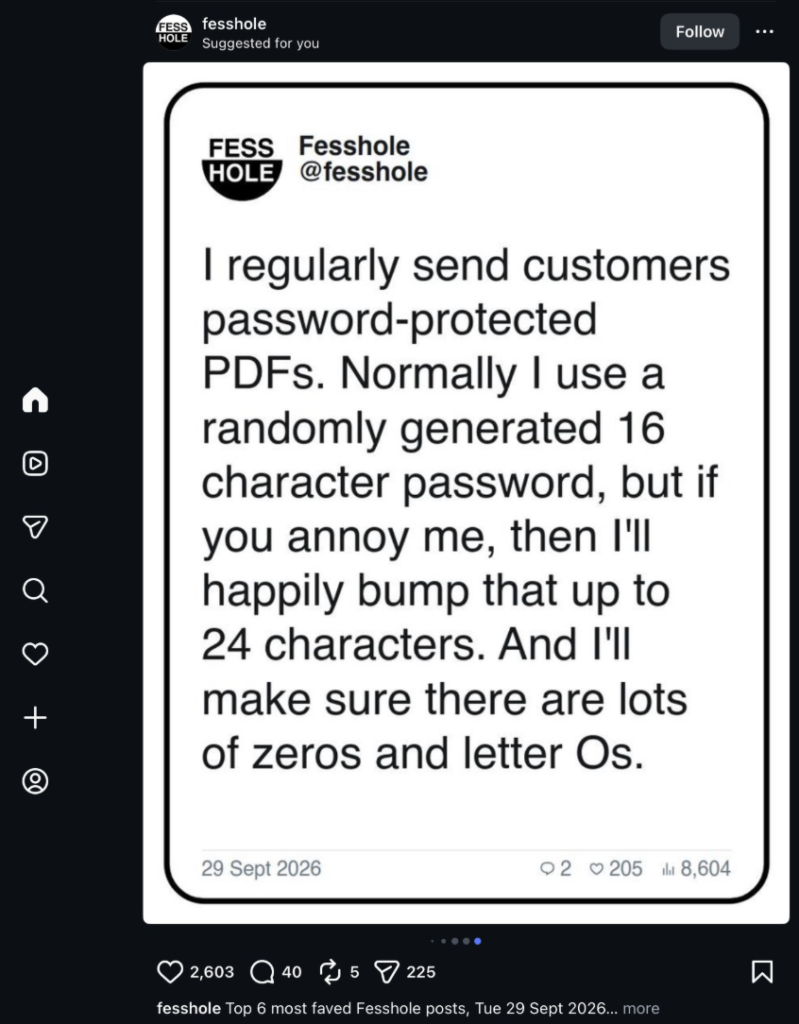
PDF Confessions
Sounds like annoying customers should be very glad this wasn’t PDF 2.0 with its Unicode password capabilities, which open up far more possibilities for hard-to-distinguish circular letterforms!
Firefox browser v158.0 ups its PDF support
Mozilla Firefox browser v158.0 included some significant new PDF features:
- “Firefox now creates more accessible PDFs when saving a page as PDF, and when printing on Linux and macOS. This also fixes a variety of PDF rendering issues, such as missing math symbols“
- “Firefox now supports the JPEG XL image format, which generally has better compression than WebP, JPEG, PNG, and GIF.” - JPEG XL is also the chosen format for HDR support in a future version of PDF!
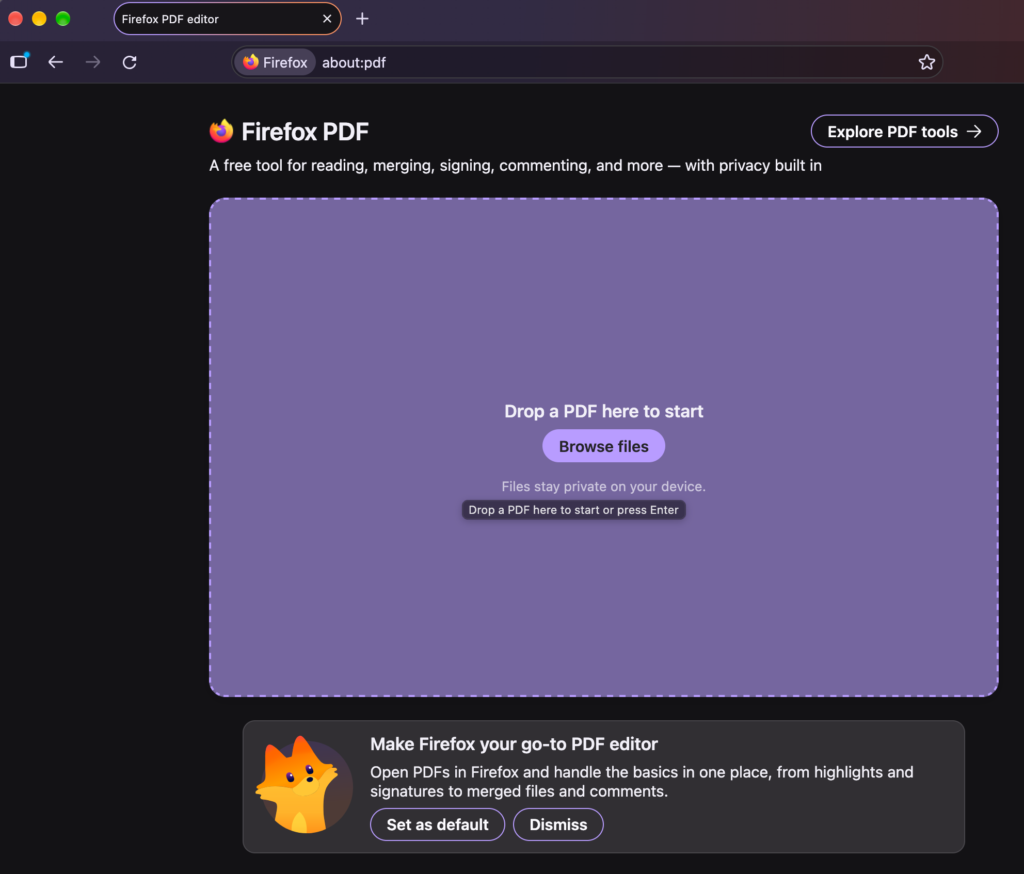
Two special browser‑internal pages will work only in Firefox. The “about:pdf” page allows users to drag and drop a local PDF file to open it in a browser tab.
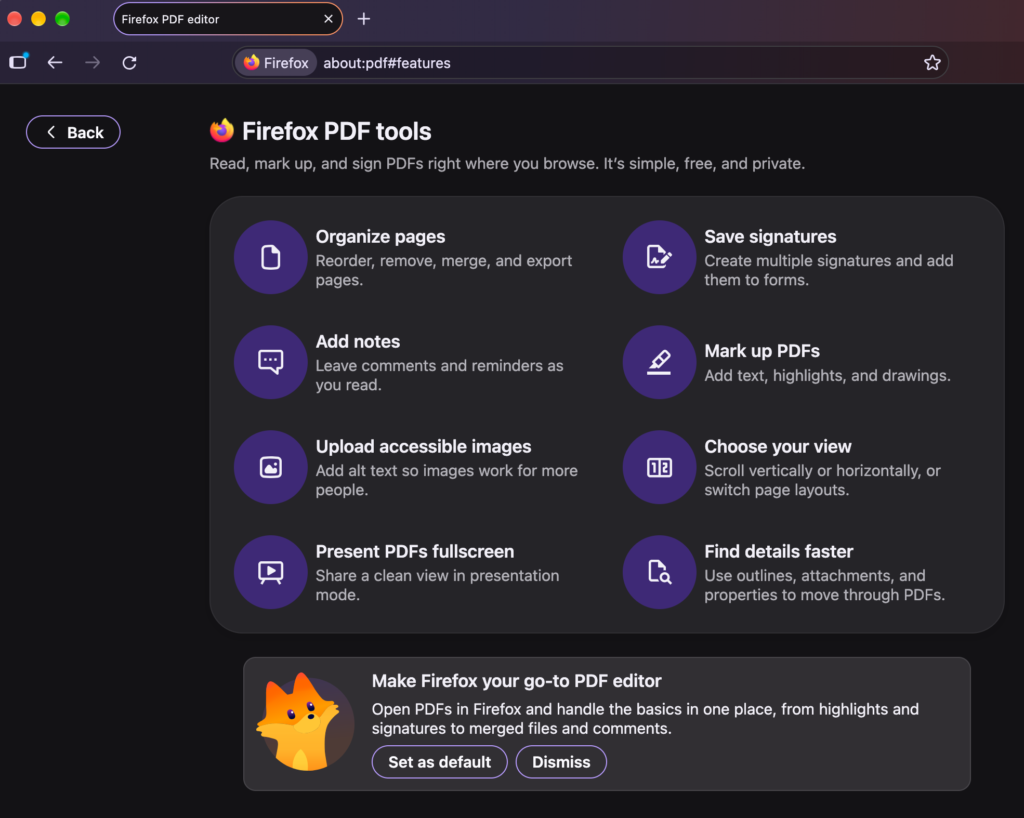
The “Explore PDF tools” button leads to the following list of capabilities at.“about:pdf#features”. As we have previously reported for Google Chrome, Firefox also misuses the term “signature” - these are NOT PDF digital signatures, but merely standard PDF annotations offering no cryptographic protection. For browsers which are otherwise highly security-aware, this misrepresentation will easily confuse many end users, and is therefore irresponsible.
Updated ISO standard for PDF processing steps
Colloquially known as “Processing steps”, a new edition of ISO 19593-1:2026 Graphic technology — Use of PDF to associate processing steps and content data — Part 1: Processing steps for packaging and labels has been published by ISO. Developed by ISO TC 130 WG 2, this 2026 2nd edition replaces the 2018 1st edition (now withdrawn) and adds support for primer and printing plate making processing steps, with additional clarity on optional content group (OCG) technical requirements.
We noted that this ISO publication was also marked as conforming to PDF/UA-1. However, when we validated the PDF, we found this to be incorrect - we have now reported this to ISO and hope that they will correct their publication processes to include the all-important validation step and regenerate this PDF.
PDFacademicBot for October 2026
The PDFacademicBot brings academic research on PDF and related technologies to the industry’s attention.
Featured research for October
John C. Bowman (2026) “V3D: Portable interactive 3D graphics for PDF and beyond,” TUGboat (TeX Users Group Journal), 47(2), pp. 230–234. https://doi.org/10.47397/tb/47-2/tb146bowman-v3d.
It’s a pity that this non-standardized variant of 3D PDF created by LaTeX via Asymptote with V3D assets in RichMedia annotations was defined when PDF has already standardized four distinct 3D formats: U3D (PDF 1.6), PRC (PDF 2.0), glTF (ISO/TS 32007, PDF 2.0), and STEP AP 242 (ISO/TS 24064, PDF 2.0). As we also recently identified, nanoPRC now offers full PRC OSS support, with multiple vendors also providing rich 3D PDF experiences of one or more of these 3D visualization formats.
A dated revision of PRC (ISO 14739-1) is currently in progress at ISO TC 171 SC 2 WG 7 with significant specification corrections and clarifications as logged in our public errata GitHub repository.
More on PDF…
Ade Sutriyono (Oct. 2026) “Design of a PDF Document Integrity Verification System Based on QR Code and SHA-256 with Local Evaluation" Jurnal Teknologi, Inustri, dan Informasi, 4(4). https://journal.awatarapublisher.com/index.php/technovatar/article/view/409 .
Astuti, N.R.D.P., Adi, K. and Widodo, C.E. (2026) “Evaluation Security of PDF Medical Documents Using AES-Genetic Algorithm Hybrid Cryptography,” 2026 International Conference on Information Technology and Computing (ICITCOM), pp. 1–5. Available at: https://doi.org/10.1109/ICITCOM70739.2026.11714367.
John C. Bowman (Sept. 2026) “V3D: Portable interactive 3D graphics for PDF and beyond,” TUGboat (TeX Users Group Journal), 47(2), pp. 230–234. https://doi.org/10.47397/tb/47-2/tb146bowman-v3d.
Carrara, A. et al. (Jan. 2027) “Recovering ontology-normalized layer classes from vector-native PDF drawings via graph-based learning,” Automation in Construction, 193, p. 107315. https://doi.org/10.1016/j.autcon.2026.107315.
Dong, Z. et al. (Sept. 2026) “Adapt Semantics, Not Structure: Few-Instance Schema Calibration for Scientific PDF Extraction.” arXiv. https://doi.org/10.48550/arXiv.2609.34841.
Fakroun, E. and Sullabi, M. (Sept. 2026) “KWSSWS-IA Approach: An Intelligent Assistant for Scientific PDF Retrieval Using Semantic Analysis and AI-Driven Summarization,” Al-Farouk journal of sciences, 2(4). https://afjs.histr.edu.ly/index.php/afjs/en/article/download/829/753.
Heher, J., Pichler, E. and More, S. (Oct. 2026) “What you see is (not) what you got: The human factor in PDF signature verification,” Computers & Security, p. 105191. https://doi.org/10.1016/j.cose.2026.105191.
Jain, C. et al. (Sept. 2026) “Creating a Large-Scale Environmental, Social and Governance (ESG) Document Corpus from Corporate PDF Sources.” https://doi.org/10.15123/gqbn-tm42.
Jakani, Y.E. et al. (Oct. 2026) “TrustPaper for forged PDF with Issuer Fingerprints.” arXiv. Preprint. https://doi.org/10.48550/arXiv.2610.14132.
Jain, G. (Sept. 2026) “PDFa11yMut: Measuring Mutation-Specific Detection in PDF Accessibility Checkers.” arXiv. https://doi.org/10.48550/arXiv.2609.33160.
Kumari, A. et al. (Sept. 2026) “Portable Document Format Text Analysis for Automated Question Answering,” Journal of Himalaya College of Engineering, 3(1). https://hcoe.edu.np/uploads/167bed27-008f-4a54-940b-7b9bd3a5bc5e.pdf
Lin, X. and Du, D. (Sept. 2026) “From PDF to Evidence: Structure-Aware Retrieval for Clinical Practice Guidelines.” arXiv. Preprint. https://doi.org/10.48550/arXiv.2609.33447.
Lo, M., Huo, X. and Cao, Y. (August 2026) “A Prototype for PDF Documents Integrity Verification Using Chinese National Cryptographic Algorithms and Hardware Isolation,” 2026 International Conference on Future and Intelligent Networking (FINE). https://doi.org/10.1109/FINE71157.2026.00022.
Millet, T. et al. (Sept. 2026) Multilayer Forensic Tampering Detection, arXiv.org. https://arxiv.org/abs/2609.38252v1.
Ogut, E. et al. (Oct. 2026) “A cross-sectional study on the perceptions, utilization, and educational needs of medical students regarding AI, 3D PDF, and deep learning,” BMC Research Notes [Preprint]. https://doi.org/10.1186/s13104-026-08084-y.
Papel, J.F. and Munaka, T. (Sept. 2026) “PDF-to-HTML Layout-Preserving Machine Translation for Multilingual Open Education Resources: Addressing Character Density Expansion Across Languages,” 2026 International Symposium on Networks, Computers and Communications (ISNCC), pp. 1–7. https://doi.org/10.1109/ISNCC70543.2026.11693847.
Trividic, Y. et al. (Oct. 2026) “‘Books are social spaces’: Challenges in Collaborating Across File Formats in Independent Publishing,” Proceedings of the ACM on Human-Computer Interaction, 10(6), pp. 1–31. https://doi.org/10.1145/3816904.
Toresan, B.R. et al. (2027) “An Automated Framework for Generating Image-Text Datasets from PDF Documents,” in M. Recamonde-Mendoza and R.C. Barros (eds.) Intelligent Systems. Cham: Springer Nature Switzerland, pp. 189–203. https://doi.org/10.1007/978-3-032-39892-5_13.
Wei, O.Z. and Omar, Z. (Sept. 2026) “Enhanced Automated Thesis Format Compliance Checker Using Hybrid Metadata Analysis and Computer Vision-Based Geometric Layout Extraction,” 2026 IEEE 9th International Conference on Signal and Image Processing Applications (ICSIPA), pp. 1–6. https://doi.org/10.1109/ICSIPA69622.2026.11720130.
Vijayalaxmi, A. and Varun, K.S. (Sept. 2026) “SmartSlide AI: An Intelligent Chatbot-Driven System for Automated PowerPoint and PDF Presentation Generation,” International Journal of Scientific Research in Engineering and Management, 10(9). https://doi.org/10.55041/IJSREM67101.
Wolfe, M. et al. (Oct. 2026) “Testing Generative Artificial Intelligence: Uncovering Inconsistencies in Eleven Generative Artificial Intelligence Tools in Mathematical Questions in A PDF,” International Journal of Research and Scientific Innovation, 13(9), pp. 1506–1530. https://ideas.repec.org/a/bjf/ijrsci/v13y2026i9p1506-1530.html.
