




Turning production knowledge into automation
Case studyJune 22, 2026
Case studyJune 22, 2026

About David van Driessche, callas software GmbH
The views expressed in this article are those of the author(s) and do not reflect the policies or positions of the PDF Association.
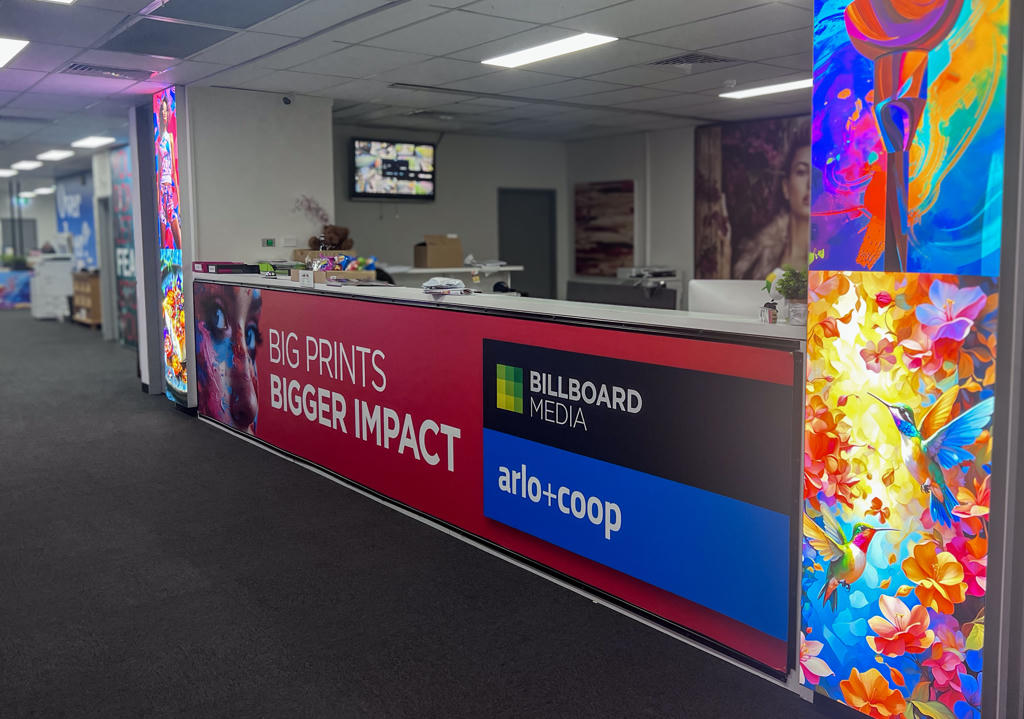
Based in Melbourne, Australia, Billboard Media has been operating for more than 40 years and has grown into one of the country’s most capable large-format, point-of-sale and corrugated packaging providers. It produces banners, billboards, self-adhesive vinyl, rigid signage, retail displays, short-run boxes, and national campaigns – often for customers who need more than straightforward print production.
“We’re primarily a trade printer,” explains Dominic Plutino, Prepress Manager. “Large format is still a big part of what we do: banners, posters, self-adhesive vinyl, rigid flatbed work, billboards. But over the years, we also moved into corrugated board, point-of-sale displays, and short-run packaging.”
All production is handled from a single Melbourne facility, serving customers across Australia. Much of the work is practical, time-sensitive, and production-driven. But some of it is more unusual.
“We get some weird requests,” Dominic says. “Of course, we print the run-of-the-mill banners you’d expect, but we also wrap buses and trams, or a whole building. For one customer, we wrapped a complete bridge. There is a lot of knowledge in the company, and people in the industry know that.”
That knowledge is valuable. It is also difficult to scale if it remains locked inside manual processes.
From custom habits to consistent data
The move toward automation started with a broader modernization project. For many years, Billboard Media had relied on a highly customized FileMaker-based system. That system had evolved with the business and contained a lot of useful custom behavior. But it also created inconsistency. Different account managers described jobs in different ways, and prepress staff had to understand how to interpret those differences.
“When everything is described differently, you end up training people to understand each person’s way of writing things,” says Dominic. “If it comes from this account manager, do this. If it comes from another, do that.”
They decided to start by implementing a new MIS system and went with PrintIQ. That decision was therefore not only about replacing one business system with another. It was about creating the data foundation for automation. The transition was not without challenges; some of the old custom behavior could not simply be carried across. But the new structure made it possible to describe jobs more consistently, connect systems more reliably, and use job data in more meaningful ways.
“We needed more standardization,” Dominic says. “We needed something more transparent, because once you have consistent data, you can start doing more things with it.” That is where callas pdfToolbox entered the picture. PrintIQ provides the job data. Enfocus Switch orchestrates the workflow. pdfToolbox then uses variables, Process Plans, and JavaScript to turn those rules into actual PDF processing.
Building around real production complexity
For Dominic, the appeal of pdfToolbox was not only that it could check and fix PDF files. It was that it could be built on. During the evaluation process, he looked at several options for automation and PDF processing. With a background in prepress, IT, web development, and scripting, he wanted tools that could go beyond standard functionality when production requirements demanded it.
“What I liked was that the software was scriptable,” he says. “I could see that a lot of tools were already there, and I could easily combine them. But if I needed to do something that was not standard, or if there was an edge case, I had a way to build around it.”
That flexibility matters because many of the company’s products are not as simple as they look. Even a product such as a banner can become surprisingly complex. It may involve different finishing on each side, with hems, pockets, rope edges, bleed, eyelets, grommets, and spacing rules all influencing the final production file. In practice, production is governed by rules and formulas rather than fixed templates.
Those rules are now handled through pdfToolbox Process Plans. Metadata from the workflow controls how the file is processed, while default values ensure that only the variables that need to change are passed to the system.
“It fits the way I think,” he says. “I can write things out, work out the maths, position things where they need to go, and build the process around the job instead of forcing the job into a fixed model. pdfToolbox doesn’t force you to use its advanced capabilities, but they are there if the production reality needs them.”
For this kind of work, pdfToolbox is not just a preflight engine. It becomes a production composition and decision-making engine. Dominic uses its imposition capabilities not only for traditional page imposition, but to position, flip, compose, and prepare large-format production files in ways that match how the company actually produces jobs. So not just quality control of incoming material, but making jobs completely production-ready.
Automation that still respects exceptions
The goal is not to automate everything blindly. Some jobs are suitable for fully automated processing. Others contain conflicts, unusual finishing combinations, or requirements that fall outside the rules. In those cases, the workflow moves the job into a manual process so that prepress can review it, clarify it with account management, correct the file, or prepare the artwork manually.
That distinction is important. Automation is not replacing expertise. It is applying production knowledge consistently, while reserving human attention for the exceptions that genuinely need it.
“There are things we deliberately kick out into a manual process,” Dominic explains. “It is there to take care of the five or ten percent that do not fit the rules.”
That has become increasingly important as skilled prepress people become harder to find. Dominic manages a small prepress team, while much of his own time is now spent on coding and automation. The more routine production knowledge can be captured in software, the more effectively the team can focus on the work that really requires experience.
For Dominic, this reflects a broader shift in print. “There is always a lot of talk about the output devices,” he says. “They get faster and smarter. But I think the frontier for print is software: the way you interact with customers, the way you connect systems, the way you use APIs, and the way companies work together.”
The role of Workflowz Australia
Billboard Media was supported in its automation journey by Workflowz Australia. Dominic approached the project with a clear idea of what he wanted to achieve and a willingness to explore different tools. What mattered was not just buying software, but finding a partner who could understand the technical requirements and recommend a solution that matched the company’s way of working.
Workflowz Australia helped evaluate the available options and introduced pdfToolbox as a strong fit for Dominic’s development-oriented approach. That distinction mattered. He did not want a closed workflow where he could only use predefined functionality. He wanted a system he could learn deeply, extend, connect, and keep building on.
Or, as explained by Alan Dixon, Managing Director of Workflowz Pty Ltd: “Billboard Media demonstrates what can happen when deep production knowledge is combined with the right automation technology. Dominic recognized early that pdfToolbox could be much more than a preflight tool; it could become a core production engine driven by business rules, job data, and real-world manufacturing requirements. Their approach shows how print companies can capture valuable expertise, reduce manual touchpoints, and create workflows that are both highly automated and flexible enough to handle complex production environments.”
Software as production capacity
Today, pdfToolbox is part of a wider automation strategy. It sits between customer artwork, job data, production rules, and output requirements. It checks files, prepares files, composes production-ready PDFs, and helps decide which jobs can flow through automatically and which need attention.
That makes it an important part of how the company scales. The business still depends on experienced people. But instead of relying on those people to repeat the same manual checks and setup tasks again and again, more of their knowledge can be turned into software-driven processes.
That is increasingly important in a market where production is becoming faster, customer expectations are rising, and skilled prepress expertise is harder to replace. “Print runs on PDFs,” Dominic says. “It is such a critical technology, but I don’t think it always gets the attention it deserves.”
At Billboard Media, that attention is producing practical results. Complex jobs can be prepared more consistently. Routine decisions can be handled automatically. Exceptions can be routed to the people who have the knowledge to resolve them. And prepress expertise can be applied across work that is anything but standard.
For a company known for taking on the hard stuff, that is exactly the point.

callas software was founded in 1995 and has focused on making PDF files usable in production environments from the start. While PDF was designed as a flexible and open format, using it reliably in production – where standardization matters – often proves challenging. callas develops technology to identify PDF files…
Read more